
Anti‑Slip Riding Crawler Rotary Tiller for Muddy & Paddy Fields
2026/09/07 09:34
1. Introduction
Wetland farming, including muddy farmland and water-filled paddy fields, has long been challenged by low mechanization efficiency and harsh operating conditions. Traditional wheel-type tillage equipment is prone to slipping, sinking and stalling on soft, water-logged soil, resulting in delayed farming schedules and increased labor costs. To solve these industry pain points, the riding crawler rotary tiller has emerged as a professional solution specially optimized for humid farming scenarios. As a high-performance muddy field rotary tiller and exclusive paddy field rotary tiller, this anti-slip crawler tiller has become a mainstream mechanization tool for global rice planting and wetland agricultural production, bringing stable business opportunities for international agricultural machinery suppliers.
Driven by global farm mechanization upgrading and labor resource shortages, the market demand for professional wetland tillage equipment continues to grow. This news article analyzes the industry background, market development status, core technical advantages, manufacturing standards and field application values of the anti-slip riding crawler rotary tiller, providing professional procurement references for global B2B buyers.
2. Industry Background: Rising Demand for Professional Wetland Tillage Equipment
Rice is one of the world’s most important food crops, with planting areas widely distributed in Southeast Asia, South Asia, Africa and Latin America. Most rice planting regions feature rainy climates and water-rich farmland, forming a large number of muddy fields and seasonal water-logged paddy fields. For a long time, these complex terrains have relied on manual tillage or simple walking-type tillers, which are low in efficiency and highly dependent on labor.
In recent years, the global rural labor outflow and rising labor costs have forced agricultural production to accelerate mechanization transformation. Ordinary wheeled tillers and small farm machines cannot adapt to soft wet soil, often causing mechanical failure and low operating efficiency. Against this background, the specialized paddy field rotary tiller and anti-slip muddy field rotary tiller have filled the market gap of wetland mechanization.
Industry market data shows that the global crawler rotary tiller market maintains a steady growth rate of 4.75% CAGR, and the market scale will continue to expand from 2025 to 2032. The upgrading demand of small and medium-sized farms in emerging agricultural countries is the core driving force for the market growth of riding crawler rotary tiller products.
3. Core Technical Advantages of Anti‑Slip Riding Crawler Rotary Tiller
3.1 Anti-Slip Crawler Chassis for Complex Wet Soil
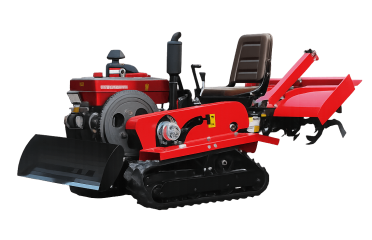
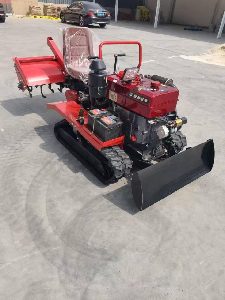
The biggest technical highlight of the riding crawler rotary tiller is the optimized anti-slip crawler system. Different from wheeled equipment, the widened steel wire reinforced rubber track greatly increases the ground contact area, effectively reducing ground pressure and avoiding sinking and skidding on muddy and water-filled soil. This core design enables the muddy field rotary tiller to operate stably in continuous rainy weather and deep-water paddy fields, realizing all-weather tillage operation.
The equipment adopts a compact body structure with a small turning radius, which can flexibly adapt to fragmented small plots, terraced fields and narrow orchard gaps that large tractors cannot enter. It supports a climbing angle of 25 to 30 degrees, fully adapting to hilly paddy planting areas in various regions.
3.2 High-Efficiency Power and Sealed Tillage System
Most mainstream anti-slip riding crawler rotary tiller models are equipped with high-quality diesel engines of 25HP to 35HP, which balance strong power output and low fuel consumption, meeting the long-hour operation needs of large-area paddy fields. The fully sealed gearbox and transmission structure effectively isolate mud, rainwater and sediment, preventing internal component damage and greatly improving the durability of the equipment in high-humidity working environments.
The rotary tillage blade is made of high-wear-resistant alloy steel, which has strong soil breaking and puddling capacity. Farmers can freely adjust the tillage depth according to rice planting standards. One machine can complete soil crushing, land leveling and straw returning operations in one pass, which is far more efficient than traditional manual and walking tillers, becoming the preferred paddy field rotary tiller for modern rice planting.
3.3 Ergonomic Riding Operation Design
Compared with traditional walking-type tillers, the riding design completely reduces the long-term labor pressure of operators. The optimized ergonomic seat and simplified control lever system make steering, depth adjustment and walking operation more convenient. It effectively solves the problem of high fatigue of field workers during continuous wetland operation, and is more suitable for large-scale and long-term farm mechanization production.
4. Manufacturing Standards and Field Application Scenarios
Qualified anti-slip riding crawler rotary tiller products adopt standardized industrial manufacturing processes. The chassis is welded with high-strength thickened steel plates, and undergoes anti-rust spraying and surface hardening treatment to adapt to long-term humid and corrosive farmland environments. Core components such as engines, sealed transmission systems and anti-slip crawler assemblies are installed in strict accordance with international production standards.
Each finished machine will pass multiple strict tests before leaving the factory, including wetland simulation operation test, waterproof performance test, tillage efficiency test and safety inspection, to ensure that every muddy field rotary tiller can maintain stable performance in harsh working conditions.
In actual agricultural production, this multi-functional paddy field rotary tiller runs through the whole rice planting cycle. It is used for land preparation and puddling before rice transplanting, field renovation and weeding during crop growth, and straw returning and soil improvement after harvest. In addition to paddy fields and muddy farmland, the equipment can also adapt to dry land, orchards and hilly terrains, with high equipment utilization rate and comprehensive cost performance.
5. Global Market Development Trends
With the continuous advancement of global farm mechanization, the market demand for professional wetland tillage equipment shows three obvious development trends. Firstly, anti-slip, waterproof and high-durability performance has become the core procurement standard, and buyers prefer professional riding crawler rotary tiller products adapted to complex terrains.
Secondly, multi-functional integration has become an important competitive advantage. Modern agricultural machinery buyers pay more attention to the multi-scene application capacity of equipment, and multi-attachment compatible muddy field rotary tiller can effectively reduce farmers’ procurement costs.
Thirdly, product certification and after-sales service systems have become key factors for B2B distributors to select suppliers. Complete qualification documents, sufficient spare parts supply and professional technical support help distributors stabilize local market share.
6. FAQ for Global B2B Importers & Distributors
Q1: What are the core parameters to confirm when sourcing riding crawler rotary tiller for wetland farming?
A: Buyers should focus on crawler anti-slip structure, engine horsepower, gearbox waterproof performance, adjustable tillage depth and chassis ground pressure. It is recommended to select enhanced anti-slip models according to local muddy and paddy field conditions to ensure stable field operation.
Q2: Can this paddy field rotary tiller be used for dry land farming?
A: Yes. The multi-functional riding crawler rotary tiller is compatible with both wetland and dry land working scenarios. It can complete tillage, ditching and soil loosening operations in dry farmland, orchards and hilly terrains, with high comprehensive utilization value.
Q3: What certifications are required for exporting muddy field rotary tiller to overseas markets?
A: European markets usually require CE certification and mechanical safety qualification documents. Most African, Southeast Asian and South American markets need factory qualification certificates and certificates of origin. Buyers are advised to confirm local customs clearance standards in advance to avoid trade risks.
Q4: What after-sales support should global distributors prioritize?
A: Distributors should confirm the supplier’s warranty policy, spare parts supply cycle, English operation and maintenance manuals, and remote technical guidance services. Complete after-sales support can effectively improve end-user satisfaction and expand local market influence.
7. Conclusion
As a professional mechanized tool for wetland agriculture, the anti-slip riding crawler rotary tiller effectively solves the operating pain points of traditional tillage equipment in muddy fields and paddy fields. With the continuous growth of global rice planting industry and the acceleration of small farm mechanization upgrading, the market demand for high-performance muddy field rotary tiller and paddy field rotary tiller will maintain steady growth.
For global agricultural machinery importers and distributors, choosing high-quality, terrain-adaptive and multi-functional crawler rotary tiller products will help seize the incremental market of wetland farm mechanization and obtain long-term and stable trade benefits.