
New Riding Crawler Rotary Tiller‑Agricultural Rotary Tiller Supplier
Global Market Background & Current Development Trend of Crawler‑Type Tillage Equipment
Labor shortage in rural areas has become one of the core driving forces for farm mechanization all over the world. More small‑and‑medium‑scale farmers, orchard operators and agricultural contractors are seeking compact, powerful land‑preparation machines that can adapt to hilly land, wet paddies and hard compacted soil conditions.
Recent industry market research shows that the global market for self‑propelled crawler rotary tillage equipment is growing steadily at a compound annual growth rate of approximately 6.22% from 2025 to 2032, and the total market value is expected to exceed USD 1.04 billion by 2032. The Asia‑Pacific region still occupies the largest market share, while demand from Latin America, Africa and Southern Europe is rising rapidly. Many traditional wheeled tillage tractors have obvious limitations on soft muddy ground or sloped orchards; wheel slip and sinking frequently reduce operating efficiency. Against this market background, the riding crawler rotary tiller has gradually turned into a preferred solution for heavy‑duty tillage on complex farmland.
Three major industry trends can be observed in this segment. First, end‑users require multi‑functional equipment rather than single‑purpose machines. Farmers hope one unit can complete rotary tilling, ditching, ridging and soil leveling by switching different attachments. Second, higher requirements are placed on operator comfort and safety; seated riding operation replaces traditional hand‑held walking models to reduce physical fatigue for long‑hour field work. Third, buyers from overseas B2B markets are paying more attention to product durability, spare‑parts supply and after‑sales support when selecting an agricultural rotary tiller supplier, instead of only comparing initial purchase prices.
Technical Design Highlights of the New Riding Crawler Rotary Tiller
Optimized Crawler Chassis for Complex Farm Terrain
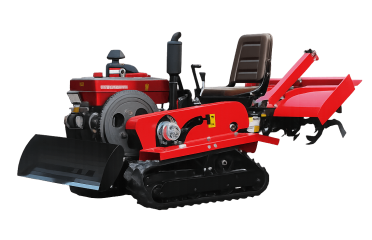
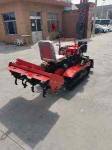
The newly‑launched riding crawler rotary tiller adopts upgraded rubber crawler tracks to lower ground pressure. Compared with wheeled tillers, the tracked chassis effectively prevents sinking on wet muddy paddies while retaining stable grip on sloped terrains and orchard ground. This design makes heavy‑duty tillage possible in narrow orchard rows and terrace farmland where large conventional tractors cannot enter.
Power System & Rotary Working Assembly
For the power unit, this riding crawler rotary tiller is fitted with a low‑emission diesel engine with sufficient torque output. Strong torque delivery guarantees stable breaking performance when working on hardened clay and compacted soil. The rotary tiller blade assembly has been optimized through repeated testing in the manufacturing workshop. During production, the blade material undergoes quenching heat‑treatment to improve wear resistance. Adjustable working depth allows operators to set tillage depth between 15 cm and 25 cm according to different crop planting requirements.
The whole manufacturing process follows strict quality control procedures. Raw material inspection, chassis welding, engine matching, assembly and field test runs are completed inside the factory workshop. Every finished riding crawler rotary tiller will go through simulated heavy‑duty tillage testing before delivery, to verify the performance of transmission, crawler walking system and rotary blades.
Practical Field Application Scenarios for the Upgraded Model
In real‑world farm operations, this riding crawler rotary tiller serves multiple types of cultivation work. In hilly dry farmland, it breaks hardened topsoil for grain crop seedbed preparation. In orchard planting areas, it carries out shallow inter‑row tillage and weed removal without damaging tree root systems. In low‑lying paddy fields, the crawler chassis keeps stable while completing muddy soil rotary tillage.
For agricultural contractors, one machine can handle different seasonal jobs across multiple customer farms. It can be equipped with optional accessories including ditching plow, ridger and bulldozer blade. This multi‑attachment capability helps reduce overall equipment investment, which is a key advantage highlighted by the agricultural rotary tiller supplier for international B2B procurement customers.
FAQ – Common Questions from Global B2B Buyers
Q1: What kind of farmland conditions is this riding crawler rotary tiller most suitable for?
A: This machine is designed mainly for hilly terraces, orchards, vegetable plots, and wet paddy fields. It performs outstandingly for heavy‑duty tillage in compacted or clay‑rich soil. It works well on narrow working spaces where big wheeled tractors cannot pass.
Q2: Can the supplier support OEM service for overseas orders?
A: Yes. As a professional agricultural rotary tiller supplier, our factory provides OEM service including custom color, logo marking, and optional attachment configuration for bulk orders. Buyers can communicate detailed OEM requirements during early‑stage project consultation.
Q3: What about after‑sales service and spare‑parts supply?
A: Standard warranty covers main engine and transmission assemblies. Spare‑parts kits can be delivered together with machine shipments. Technical support is available via online video guidance for daily maintenance and basic field repair work.
Q4: Is operator training material available in English?
A: English‑language operation manuals and safety guidelines are supplied with each unit. For large‑volume client orders, we can also provide remote online operator training sessions upon request.
Final Remarks for Global Procurement
As farm mechanization keeps advancing worldwide, the demand for reliable riding crawler rotary tiller products will keep growing. Choosing a responsible agricultural rotary tiller supplier is essential for importers, distributors and farm contractors. This new‑generation model balances powerful heavy‑duty tillage capability, flexible cross‑terrain mobility and reasonable operating costs. Distributors and end‑farm users are welcome to make product inquiries, request technical specification sheets and discuss bulk cooperation possibilities.