
Riding Crawler Rotary Tiller: Power and Precision
Industry Background and Market Context
The Global Shift Toward Mechanized Tillage
The worldwide farm machinery and equipment market reached USD 247.66 billion in 2026, growing at a compound annual growth rate of 5.1%, with labor scarcity and rising crop productivity requirements cited as primary demand drivers. Within this broader landscape, the soil tillage equipment segment expanded from USD 6.33 billion in 2025 to USD 6.66 billion in 2026 and is forecast to reach USD 8.86 billion by 2032, reflecting sustained investment in seedbed preparation technology.
The rotavator market specifically is valued at approximately USD 3.28 billion in 2026 and projected to grow to USD 4.80 billion by 2032 at a CAGR of 6.49%. The Asia-Pacific region dominates adoption, accounting for roughly 55.5% of market growth during the forecast period, driven by high cropping intensity, large smallholder populations, and government-supported mechanization initiatives across rice-producing nations.
Why Crawler Self-Propelled Models Are Gaining Share
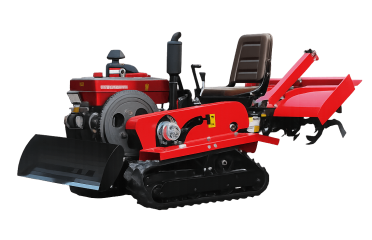
Within the tiller market, the crawler self-propelled segment is outpacing conventional tractor-mounted and walk-behind alternatives. This shift reflects a fundamental recognition among farmers that wheeled machinery often fails in the saturated, uneven terrain typical of paddy fields. The Riding Crawler Rotary Tiller addresses this limitation through its tracked undercarriage, which distributes weight evenly and prevents sinking—an advantage that directly translates into fewer operational disruptions and higher daily throughput.
Technical Advantages and Performance
Superior Traction and Flotation
The defining engineering feature of a crawler-based Farm Tiller is its track system. Unlike wheeled tractors that concentrate weight on four contact points, crawler tracks spread machine mass across the entire track footprint, reducing ground pressure significantly. Field studies indicate that this design cuts soil compaction by up to 50%, protecting the paddy field's hardpan layer and boosting rice germination rates to over 80%—a substantial improvement over wheeled alternatives.
Modern crawler tillers can traverse mud pits up to 30 centimeters deep and maintain stable operation on slopes ranging from 10 to 15 degrees. The compact chassis and tight turning radius—some models offering pivot steering—enable these machines to work efficiently in narrow terraced plots and smallholder fields where larger equipment simply cannot maneuver.
Operator Ergonomics and Productivity
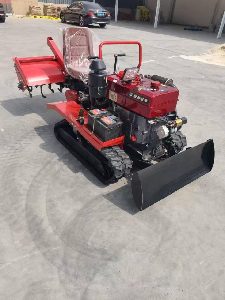
The riding configuration represents a major leap from walk-behind power tillers. An elevated, ergonomically designed operator seat with intuitive controls reduces physical fatigue during extended working sessions. Flagship models introduced in 2025 feature 100hp water-cooled engines, 330mm ground clearance, and simplified one-lever operation systems that minimize training time and reduce operator error.
In practical terms, an 80 to 100hp riding crawler rotary tiller can cover 3 to 6 hectares per day in paddy conditions and up to 7 to 10 hectares in lighter dryland soils, depending on tilling depth and field geometry. This throughput makes the machine economically viable for both large-scale operations and custom-hire service providers.
Technology Trends Shaping the Category
Intelligent Control and Telematics
The latest generation of Riding Crawler Rotary Tiller models integrates electronic control units that continuously adjust engine output and tiller rotational speed based on real-time soil resistance. This adaptive control improves fuel efficiency by an estimated 15 to 20 percent while ensuring consistent tilling depth across variable soil conditions.
GPS-enabled telematics systems allow fleet managers to monitor machine location, fuel consumption, working hours, and maintenance schedules remotely. For agricultural contractors managing multiple units across dispersed sites, this data visibility is a game-changer for operational planning and cost control.
Automation and Autonomous Navigation
Research into autonomous tillage is advancing rapidly. Academic and industry teams have developed ROS-based guidance platforms using embedded AI controllers, enabling crawler tillers to follow pre-mapped field paths with centimeter-level accuracy. While full commercial autonomy remains in early deployment, semi-autonomous features such as auto-steering and headland turn automation are already available on premium models.
Sustainability and Emission Compliance
Manufacturers are responding to global environmental regulations by introducing Tier 4-compliant engines and biofuel-compatible powertrains. These advances reduce exhaust emissions and broaden the application potential of crawler tillers in environmentally sensitive regions. Modular attachment systems further enhance sustainability by allowing a single base machine to perform rotary tilling, ditching, weeding, and earth-pushing tasks, maximizing utilization and reducing the need for multiple dedicated machines.
Manufacturing and Application Process
How a Riding Crawler Rotary Tiller Is Built
Production of a Paddy Field Tiller follows a rigorous, multi-stage manufacturing process. The structural frame is fabricated from high-strength steel through precision laser cutting and robotic welding, then finished with multi-layer anti-corrosion coating. The track undercarriage assembly uses forged sprockets, tensioned idler wheels, and sealed track links engineered for thousands of operating hours. The rotary tiller shaft undergoes dynamic balancing to eliminate vibration at high rotational speeds. Final assembly integrates the diesel engine, multi-gear transmission, hydraulic control system, and operator platform. Every completed unit undergoes comprehensive field testing under simulated soil conditions before receiving quality certification and shipment.
Field Application Workflow
In a typical paddy field application, the operator first floods the field to soften the soil. The crawler tiller then enters with the rotary cutter engaged at a prescribed depth, typically 10 to 15 centimeters. As the machine advances, the rotating blades cut, mix, and pulverize soil and stubble, creating a uniform puddle ideal for transplanting or direct seeding. The operator adjusts forward speed and tiller depth via hydraulic controls to match soil conditions. After tilling, the same machine can be reconfigured with alternative attachments for secondary operations such as ridging or weed removal.
Frequently Asked Questions (FAQ)
Q1: How does a riding crawler rotary tiller compare to a tractor-mounted tiller?
A riding crawler rotary tiller is a fully self-propelled, integrated machine with its own engine, tracks, and operator station, whereas a tractor-mounted tiller requires a separate tractor to provide power and mobility. The crawler version offers superior flotation in wet conditions, better maneuverability in small or sloped fields, and eliminates the need to own or rent a compatible tractor. Tractor-mounted tillers may be more economical for large, dry operations where a tractor fleet already exists.
Q2: What is the typical daily working capacity of a paddy field tiller?
A standard 80 to 100hp crawler paddy field tiller can process 3 to 6 hectares per day in saturated paddy conditions and 7 to 10 hectares per day in lighter dryland soils. Actual output varies based on soil type, tilling depth, field shape, obstacle density, and operator experience. Machines in the 25 to 50hp compact range typically cover 1 to 3 hectares per day and are suited for smallholder farms.
Q3: What maintenance schedule should buyers expect?
Daily maintenance includes checking track tension, inspecting for damage, and rinsing the machine with fresh water after paddy operation to prevent corrosion. Engine oil and filters should be changed every 100 to 200 operating hours. The tiller shaft bearings and track links require inspection every 500 hours, and the hydraulic system should be serviced annually. Following the manufacturer's maintenance schedule is critical for maximizing service life and preserving resale value.
Q4: Are these machines suitable for small farms?
table for small farms?Yes. Many manufacturers offer compact 25 to 50hp models specifically designed for smallholder farms, terraced plots, and between-row orchard cultivation. These units feature narrow track widths, minimal turning radius, and accessible pricing. For farms below 2 hectares, cooperative ownership or custom hiring services—where machine owners provide tillage services on a per-hectare basis—often represent the most cost-effective path to mechanization.
Conclusion
The Riding Crawler Rotary Tiller stands at the intersection of power, precision, and practical adaptability. As the global tillage equipment market continues its steady expansion toward USD 8.86 billion by 2032, the crawler self-propelled segment is positioned for above-average growth, fueled by paddy field mechanization across Asia-Pacific and rising demand for low-compaction, conservation-friendly tillage solutions. For international B2B buyers—whether distributors expanding product lines, farm cooperatives upgrading fleets, or contractors seeking higher utilization—investing in a quality Paddy Field Tiller with crawler propulsion means lower operational costs, higher yields, and future-ready compatibility with emerging autonomous and precision agriculture technologies. The modern Farm Tiller is no longer merely a soil-preparation implement; it is a productivity platform that will underpin the next decade of sustainable, efficient global farming.