
Wheel Tractor Buying Guide: Core Criteria for Agricultural Importers
2026/08/22 14:59
Global Wheel Tractor Market Overview and Industry Trends
The global wheel tractor industry maintains stable and positive growth, benefiting from the continuous advancement of agricultural modernization in emerging economies and the renewal of old equipment in mature agricultural regions. According to professional industry market data, the global wheel tractor market was valued at approximately USD 68.4 billion in 2025, with a projected compound annual growth rate of 4.9% from 2026 to 2034, and the market scale is expected to reach USD 105.7 billion by 2034.
Regional market demand presents distinct characteristics. The Asia-Pacific region occupies the largest market share, relying on large-scale cultivated land resources and continuous agricultural mechanization upgrading. Africa, Latin America and Southeast Asia have become the fastest-growing emerging markets, with local governments actively promoting farm mechanization to solve the problems of labor shortage and low farming efficiency. As the main procurement group in the cross-border agricultural machinery industry, agricultural importers are shifting their purchasing logic from low-price priority to comprehensive consideration of performance, durability, adaptability and after-sales service.
In recent years, the market demand for multi-functional, energy-saving and high-efficiency agricultural wheel tractor has increased significantly. Traditional single-function wheel tractor can no longer meet the diversified operation needs of modern farms. More buyers tend to choose general-purpose wheel tractor that can be matched with multiple accessories to realize multiple farming operations, so as to reduce equipment investment costs and improve comprehensive farming benefits. This trend has become a key reference for agricultural importers to formulate annual procurement plans.
Core Selection Criteria for Agricultural Importers to Evaluate Wheel Tractor
For professional agricultural importers, purchasing wheel tractor is a systematic project that needs to combine local climate environment, farm scale, farming types, policy standards and after-sales operation conditions. The following core evaluation dimensions can help buyers avoid selection mistakes and improve procurement accuracy.
1. Power Configuration Matching Local Farming Scenarios
Power parameter is the core indicator to determine the working capacity of wheel tractor. Agricultural importers need to select power models according to local cultivated land area and operation types. Small-power wheel tractor (20-50HP) is suitable for small and medium-sized farms, hilly land and fine farming operations such as sowing and sprinkling irrigation. Medium-power wheel tractor (50-100HP) is widely used in conventional plowing, harrowing and crop harvesting, and is the most mainstream model purchased by global agricultural importers.
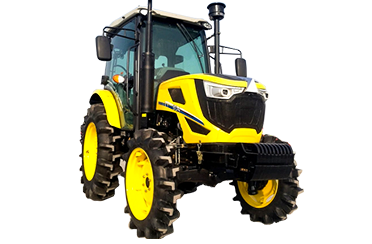
High-power wheel tractor (above 100HP) is oriented to large-scale mechanized farms, suitable for deep plowing, land reclamation and heavy-load continuous operation. In addition, 2WD and 4WD configurations need to be matched according to land conditions: 4WD agricultural wheel tractor has stronger traction and anti-skid performance, adapting to muddy, rugged and wet farmland, while 2WD models are more cost-effective for flat and dry land operations.
2. Structural Durability and Environmental Adaptability
Most overseas farmland operations have the characteristics of long working hours and harsh environments, which put forward high requirements on the durability of wheel tractor. Formal agricultural wheel tractor adopts high-strength steel frame and reinforced chassis structure, which can resist frequent vibration and heavy load impact during long-term farming. Key components such as engine, transmission and hydraulic system are core inspection objects for agricultural importers.
In view of the high temperature, dust, rainy and humid environments in tropical and subtropical regions, qualified wheel tractor needs to be equipped with dust-proof, waterproof and heat dissipation optimization designs to reduce component failure rate. Products with excellent environmental adaptability can effectively reduce equipment downtime and maintenance costs, which is the key to long-term profitable operation for distributors and terminal farmers.
3. Energy-Saving Performance and Total Operation Cost
More than 60% of global agricultural importers take fuel economy as a key evaluation index for wheel tractor procurement. Modern high-quality agricultural wheel tractor is equipped with optimized fuel-efficient engines and intelligent fuel supply systems, which can effectively reduce unit farming fuel consumption. Compared with ordinary models, energy-saving wheel tractor can save 10%-15% of fuel cost annually for terminal users, greatly improving the market competitiveness of imported equipment.
In addition to fuel consumption, agricultural importers need to comprehensively assess the total cost of equipment, including spare parts replacement cost, maintenance difficulty and service life. High-quality wheel tractor has standardized component design and universal spare parts, which facilitates later maintenance and reduces the comprehensive operating cost of farm equipment.
4. Emission Standards and Policy Compliance
Different countries and regions have clear access standards for imported agricultural machinery. Agricultural importers must confirm local environmental protection emission regulations in advance to select compliant wheel tractor models. At present, mainstream global markets support Euro III and Euro IV emission standards, and some developed regions have higher environmental protection requirements. Purchasing compliant agricultural wheel tractor can avoid customs clearance risks and policy restrictions, ensuring smooth equipment sales and terminal use.
5. After-Sales Service and Spare Parts Support System
Perfect after-sales support is an important guarantee for agricultural importers to expand local market share. Excellent wheel tractor manufacturers provide complete operation manuals, multi-language maintenance guidelines and global warranty services. For cross-border procurement, stable spare parts supply channels and remote technical guidance are particularly important, which can help distributors solve terminal equipment faults in a timely manner and improve customer satisfaction and repurchase rate.
Manufacturing Advantages of Standard Agricultural Wheel Tractor
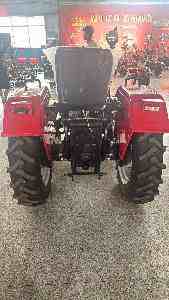
Regular high-quality agricultural wheel tractor undergoes standardized industrial production and strict quality inspection. The whole manufacturing process adopts automated welding and precision assembly technology, with strict quality control for chassis, engine, hydraulic system and other core components. Before leaving the factory, each wheel tractor will pass continuous load operation test, environmental simulation test and performance calibration to ensure that the equipment can adapt to various complex farming scenarios.
In terms of functional design, mainstream agricultural wheel tractor supports multi-functional accessory docking, which can be matched with plow, harrow, seeder, fertilizer spreader and harvesting tools to realize one machine with multiple functions, fully meeting the diversified operation needs of modern agriculture and bringing higher economic benefits for agricultural importers and terminal farmers.
FAQ – Common Questions for Global Agricultural Importers
Q1: How to choose the right wheel tractor power for regional farmland?
A: For hilly, small and scattered farmland, 20-50HP small wheel tractor is the best choice; for conventional flat farmland and daily farming operations, 50-100HP medium-power agricultural wheel tractor is the most cost-effective; for large-scale farms and heavy-load land reclamation operations, it is recommended to select high-power 4WD wheel tractor to ensure operation efficiency and stability.
Q2: What is the biggest advantage of Chinese-made wheel tractor for agricultural importers?
A: Chinese-manufactured wheel tractor has outstanding comprehensive advantages in cost performance, structural durability and functional richness. While ensuring international standard production quality, it has lower purchase and maintenance costs compared with European and American brands. In addition, manufacturers support personalized configuration customization, which can accurately meet the differentiated market needs of global agricultural importers.
Q3: What risks should be avoided in cross-border wheel tractor procurement?
A: Agricultural importers need to focus on avoiding three major risks: non-compliance with local emission standards leading to customs clearance failure, insufficient equipment environmental adaptability leading to high failure rate, and imperfect spare parts supply system leading to difficult after-sales maintenance. It is recommended to cooperate with formal manufacturers with complete qualification certificates and perfect after-sales system.
Q4: Is customized configuration of agricultural wheel tractor supported for regional markets?
A: Yes. Professional manufacturers can provide customized services according to the needs of agricultural importers, including power adjustment, emission standard upgrade, dust-proof and waterproof reinforcement, cab optimization and multi-functional accessory matching, to ensure that the wheel tractor can fully adapt to local climate, farmland conditions and farming habits.
Market Outlook
With the continuous deepening of global agricultural mechanization and precision agriculture development, the market demand for high-efficiency, energy-saving and multi-functional wheel tractor will continue to grow. For agricultural importers, scientific selection based on regional market characteristics and farming needs is the core of improving procurement benefits and market competitiveness. Adhering to the above selection criteria can help global buyers screen high-quality agricultural wheel tractor products, stabilize terminal customer resources, and seize the development opportunities of the global agricultural machinery market.