
Reliable Wheel Tractor for Modern Farming
Global Modern Farming Drives Strong Demand for Reliable Wheel Tractor
Global agriculture is undergoing large‑scale mechanization transformation in 2026. As farm sizes expand and labor costs keep rising across continents, modern farming tractor has become core capital equipment for small family farms, large commercial plantations and agricultural contractors worldwide. The global wheel tractor market is estimated at USD 61.66 billion in 2026, and it is projected to maintain steady growth with a compound annual growth rate of 4.91% from 2026 to 2035. For international B2B buyers including importers, distributors and farm fleet operators, choosing a durable and reliable wheel tractor directly influences long‑term farm productivity and return on investment.
An agricultural wheel tractor undertakes most heavy‑load field tasks: ploughing, tillage, sowing, fertilizing, harvesting assistance and material transportation. In emerging agricultural markets of Asia, Africa and Latin America, governments keep promoting farm mechanization policies, which significantly boost import volume of cost‑effective wheel tractor units. Meanwhile, European and North‑American markets push forward stricter non‑road emission standards, forcing manufacturers to upgrade engine configurations for lower exhaust output, higher stability and longer service life. Under such market background, reliability, rather than only horsepower parameter, turns into one of the top concerns when buyers source modern farming tractor for long‑term field operations.
Core Technical Features of Reliable Wheel Tractor for Agricultural Production
Robust Powertrain and Durable Transmission Assembly
A qualified reliable wheel tractor starts from solid powertrain matching. Most mainstream agricultural wheel tractor adopts water‑cooled turbocharged diesel engines optimized for variable field working conditions, delivering stable torque output under heavy tillage loads. Matched heavy‑duty gearbox provides abundant forward and reverse gear combinations, allowing operators to adjust travelling speed according to soil texture, implement types and working requirements. Reinforced clutch and drive axle components reduce failure risks under frequent start‑stop and high‑torque operations, cutting unexpected downtime on farmland.
Many modern farming tractor models integrate optimized hydraulic systems with multi‑way control valves and high‑flow hydraulic pumps. The three‑point hitch structure supports quick connection with various farm implements, such as ploughs, harrows, seeders and balers. Stable hydraulic lifting capacity guarantees consistent performance even working on sloped or uneven farmland, which is a key indicator to judge whether one wheel tractor can sustain long‑time continuous agricultural work.
Human‑Centered Cabin and Multi‑Terrain Adaptability
Reliability also reflects in operator‑friendly design for long‑shift farming work. ROPS‑FOPS certified enclosed cabins protect drivers against flying debris and roll‑over risks, complying with international agricultural machinery safety standards. Vibration‑reduction suspension seats, efficient ventilation and clear instrument panels help lower operator fatigue during all‑day field tasks.
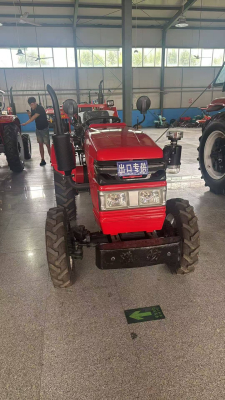
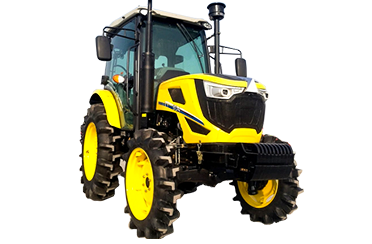
Different farmland environments raise high requirements for chassis and walking components. The agricultural wheel tractor is fitted with deep‑pattern farm tires for improved grip on muddy, dry or hilly fields. 2‑wheel‑drive and 4‑wheel‑drive optional configurations enable buyers to select proper versions for local soil and terrain conditions. One major advantage of modern farming tractor lies in multi‑implement compatibility; a single wheel tractor can finish multiple farming cycles by switching attachments, helping farms control overall equipment procurement expenditure.
Manufacturing Workflow and Typical Application Scenarios of Agricultural Wheel Tractor
During factory production of reliable wheel tractor, the whole manufacturing procedure follows strict quality control standards. High‑strength steel frames are welded by automated robotic equipment to guarantee structural rigidity under heavy‑load conditions. Factories carry out powertrain assembly, hydraulic pipeline layout, cabin installation and electrical circuit debugging step‑by‑step. Every finished agricultural wheel tractor will pass full‑machine running‑in testing under simulated field load before shipment. Manufacturers can configure engines meeting Stage V, EPA Tier‑4 or local emission norms according to target export regions, so as to satisfy different market access requirements.
In real‑world modern farming workflows, the wheel tractor runs through the whole agricultural cycle. In pre‑planting seasons, it connects with plough and harrow to complete soil preparation work. During sowing periods, it pulls seeders and fertilizer spreaders for precise field planting. After harvest, the agricultural wheel tractor works with trailers to transport grain and farm supplies, and also supports post‑season land consolidation. For medium‑and‑large‑scale farms, multiple modern farming tractor units can cooperate to shorten farming windows, avoiding yield losses caused by delayed field operations.

Key Industry Trends Reshaping Wheel Tractor Global Procurement
Three major trends are changing purchasing logic for global B2B buyers sourcing wheel tractor in 2026. First, intelligence and telematics functions gain wider popularity. More modern farming tractor are equipped with remote monitoring modules, supporting real‑time tracking of working hours, fuel consumption and fault codes. Fleet managers can conduct predictive maintenance for agricultural wheel tractor, greatly lowering sudden breakdown probability in busy farming seasons.
Second, emission compliance becomes non‑negotiable procurement condition. Regional environmental regulations keep upgrading. Buyers must confirm engine certification documents before importing wheel tractor, otherwise they will face customs clearance obstacles or in‑market usage restrictions.
Third, international importers pay more attention to total cost of ownership instead of only initial purchase price. When comparing different agricultural wheel tractor solutions, professional buyers evaluate spare‑part supply accessibility, local after‑sales service network and complete machine service cycle. Suppliers with systematic global service support obtain stronger competitive advantages for bulk‑order cooperation of modern farming tractor.
FAQ — Common Questions from International B2B Buyers
Q1: How to confirm whether a wheel tractor is reliable enough for continuous modern farming tasks?
A: Buyers shall check core component quality, factory load‑test records, ROPS‑FOPS safety certification and matching emission documents. Reference real‑user feedback from farms with similar soil conditions is also helpful. Prioritize agricultural wheel tractor with mature spare‑part supply rather than only focusing on nominal horsepower data.
Q2: What power range of modern farming tractor suits most general‑purpose farm operations?
A: For small‑and‑medium‑size family farms, 40‑80 HP wheel tractor is widely adopted. For large‑scale commercial plantations with heavy‑duty deep‑ploughing and large implement requirements, choose 90‑160 HP agricultural wheel tractor. Farm acreage, soil hardness and matched implements are decisive factors for power‑grade selection.
Q3: What key certifications are required for importing agricultural wheel tractor to overseas markets?
A: Basic certifications include ISO quality system certificate and ROPS‑FOPS cabin certificate. European markets require CE and Stage‑V emission compliance; North America needs EPA Tier‑4 documents. Buyers should confirm local mandatory standards before placing orders for modern farming tractor.
Q4: What regular maintenance can extend the service life of reliable wheel tractor?
A: Follow official service manuals to replace engine oil, filter elements and hydraulic oil on schedule. Inspect tire condition, hydraulic pipeline sealing and clutch wear status periodically. It is recommended to purchase a set of core wearing spare parts together with the agricultural wheel tractor for emergency field replacement.
Conclusion
Reliable wheel tractor remains irreplaceable backbone equipment for modern farming. Driven by global agricultural mechanization progress, market demand for qualified agricultural wheel tractor will keep expanding in the next decade. International B2B buyers should balance structural durability, power‑matching performance, certification compliance and after‑sales guarantee when selecting modern farming tractor. Properly‑chosen wheel tractor will deliver stable output, reduce field downtime and create tangible economic benefits for farms, distributors and agricultural contractors across global farmlands.