
Riding Crawler Rotary Tiller: Durable Power for Modern Farms
Market Data and Growth Projections
Recent industry reports underscore the robust growth trajectory of the tillage machinery sector. The global rotary tiller market was valued at approximately USD 1.65 billion in 2025 and is projected to reach USD 2.34 billion by 2032, expanding at a compound annual growth rate (CAGR) of 5.14%. Meanwhile, the broader soil tillage implements market is estimated to reach USD 5.8 billion in 2026 and is projected to attain USD 8.26 billion by 2036, reflecting sustained demand across both developed and emerging agricultural markets.
The agricultural crawler tractors segment is experiencing even stronger momentum. Valued at USD 1.87 billion in 2025, this market is forecast to reach USD 2.79 billion by 2032, growing at a CAGR of 5.85%. This growth is particularly significant because the riding crawler rotary tiller combines the traction advantages of crawler technology with the soil-processing efficiency of rotary tillage, creating a product category that sits at the intersection of two high-growth markets.
China's role as a leading exporter of agricultural machinery further amplifies this trend. In 2025, China's agricultural machinery exports reached RMB 67.42 billion, representing a year-on-year increase of 32.3%, with products now reaching over 100 countries and regions. This expansion signals that Chinese-manufactured farm tillage equipment is increasingly competitive in global B2B markets, offering buyers an attractive balance of performance, durability, and cost-effectiveness.
The Rise of Crawler-Based Agricultural Machinery
Crawler-tracked machinery has gained significant traction in farming due to its superior flotation and reduced soil compaction compared to wheeled alternatives. The global rubber track agricultural equipment market was valued at approximately USD 3.88 billion in 2025 and is projected to reach USD 5.52 billion by 2035, growing at a CAGR of 3.80%. This growth reflects a broader industry recognition that crawler systems minimize ground pressure, protect soil structure, and provide reliable traction in challenging conditions—including wet paddy fields, steep slopes, and loose or sandy soils.
For buyers evaluating a rotary tiller for farms, the crawler configuration offers distinct advantages in environments where wheeled machines may struggle with slippage or cause excessive compaction. This is particularly relevant for rice-growing regions in Southeast Asia, parts of South America, and delta farming areas worldwide, where field conditions demand equipment that can operate effectively without becoming bogged down.
Technology Behind the Riding Crawler Rotary Tiller
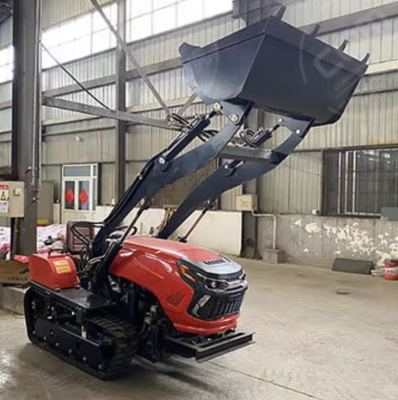
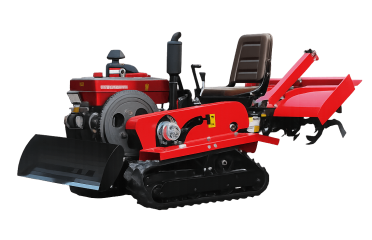
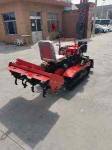
A riding crawler rotary tiller is an integrated, self-propelled machine that combines a crawler chassis, an operator station, and a rear-mounted rotary tillage assembly into a single cohesive unit. Unlike tractor-mounted tillers that require a separate tractor and implement, the riding design consolidates power, traction, and tillage into one machine, reducing overall complexity and improving maneuverability in confined spaces.
The core technical components include a diesel engine—typically ranging from 25 to 80 horsepower depending on the model—connected to a hydrostatic or gear-based transmission system that drives both the crawler tracks and the rear PTO (power take-off) for the rotary tiller. The tiller assembly itself features a horizontal rotor shaft fitted with multiple curved blades (L-shaped or C-shaped tines) that rotate at high speed, breaking up soil, incorporating crop residue, and creating a fine, uniform seedbed in a single pass.
Modern units often include adjustable tillage depth controls—typically ranging from 10 to 25 centimeters—allowing operators to match tillage intensity to specific crop requirements and soil conditions. Some advanced models also feature hydraulic lift systems for the tiller assembly, enabling quick transition between transport and working modes, as well as differential steering for tight turning radii at field headlands.
How It Works: Manufacturing and Application Process
The manufacturing process of a riding crawler rotary tiller begins with the fabrication of the chassis frame, typically constructed from high-strength steel using precision welding and robotic assembly to ensure structural integrity under heavy loads. The crawler undercarriage—consisting of rubber or steel tracks, drive sprockets, idler wheels, and track rollers—is assembled and tested for tension alignment and durability.
The engine and transmission are then mounted and integrated with the hydraulic system, followed by installation of the operator platform, which includes the seat, steering controls, instrument panel, and safety features such as ROPS (rollover protective structure). The rear rotary tiller assembly is manufactured separately, with blades heat-treated for wear resistance before being bolted to the rotor shaft. Final assembly involves connecting the PTO driveline, installing belts and guards, and conducting comprehensive performance testing—including track alignment verification, tiller balance testing, and full-load engine run-in.
In field application, the operator rides on the machine, engaging the crawler drive to move forward while the rear rotor spins, pulverizing and mixing the topsoil. The machine's weight, distributed across the wide crawler tracks, ensures consistent blade penetration even in harder soils, while the low ground pressure prevents compaction of the underlying soil layers. A single pass typically achieves both primary and secondary tillage, eliminating the need for separate plowing and harrowing operations and significantly reducing field preparation time.
Key Advantages for B2B Buyers
For agricultural contractors and large-scale farming operations, investing in a riding crawler rotary tiller delivers measurable operational and financial benefits. The integrated design eliminates the need to match tractor horsepower with compatible implements, simplifying fleet management and reducing the number of machines required for tillage operations. This consolidation translates to lower capital expenditure, reduced maintenance overhead, and fewer operator training requirements.
The crawler track system provides superior traction in wet and muddy conditions, extending the operational window during rainy seasons and enabling earlier field entry in spring—critical factors for maximizing planting windows and crop yields. Additionally, the reduced ground pressure of crawler machines minimizes soil compaction, preserving soil structure and promoting healthier root development, which contributes to long-term soil fertility and crop productivity.
From a total cost of ownership perspective, the riding crawler rotary tiller offers favorable economics. Its ability to complete primary and secondary tillage in a single pass reduces fuel consumption per hectare compared to multi-pass conventional systems. The robust construction and use of wear-resistant components—particularly heat-treated tiller blades and reinforced undercarriage parts—contribute to extended service life and lower replacement part costs over the machine's lifecycle. For B2B buyers managing large fleets, these savings accumulate rapidly, improving overall operational margins.
Market Trends: What's Shaping the Future
Several trends are reshaping the farm tillage equipment landscape and influencing purchasing decisions in the B2B segment. First, precision agriculture technologies are increasingly integrated into tillage machinery. More than 24% of new crawler tractors launched globally now include automated track adjustment and GPS navigation systems, and this trend is extending to riding tillers as manufacturers seek to offer features such as auto-steering, section control, and telematics-based fleet monitoring.
Second, sustainability and environmental regulations are driving demand for equipment that supports conservation tillage practices. Reduced-till and no-till farming methods require specialized tillage equipment that minimizes soil disturbance while effectively managing crop residue. The riding crawler rotary tiller, with its adjustable depth control and ability to precisely incorporate residue, aligns well with these evolving agronomic practices.
Third, electrification is emerging as a long-term trend in agricultural machinery. The global electric crawler tractor market is projected to grow at a CAGR of 21.52% from 2025 to 2032, and while electric riding tillers are still in early stages of commercialization, manufacturers are investing in hybrid and fully electric powertrains that offer reduced emissions, lower noise levels, and potentially lower operating costs. B2B buyers should monitor this trend as it may influence fleet replacement strategies in the coming decade.
Finally, the shift toward agricultural mechanization in emerging markets—particularly in Southeast Asia, Sub-Saharan Africa, and parts of Latin America—represents a significant growth opportunity. As smallholder farmers consolidate into larger operations and government mechanization programs expand, demand for affordable, durable, and versatile rotary tiller for farms solutions is expected to accelerate.
Frequently Asked Questions (FAQ)
What is the difference between a riding crawler rotary tiller and a conventional wheeled tiller?
A riding crawler rotary tiller is a self-propelled, integrated machine with crawler tracks and an operator station, whereas a conventional wheeled tiller is typically an implement mounted behind a wheeled tractor. The crawler design offers superior traction, lower ground pressure, and reduced soil compaction, making it better suited for wet fields, paddy rice cultivation, and sloped terrain. The riding configuration also provides better visibility and operator comfort compared to walk-behind or tractor-drawn alternatives.
What maintenance is required for a riding crawler rotary tiller?
Regular maintenance includes daily checks of engine oil, coolant, and hydraulic fluid levels; weekly inspection of track tension and undercarriage components for wear; periodic replacement of engine oil and filters (typically every 100–200 operating hours); inspection and replacement of worn tiller blades (depending on soil abrasiveness, typically every 200–500 hours); and annual servicing of the transmission and PTO driveline. Following the manufacturer's maintenance schedule is essential to maximize machine lifespan and preserve warranty coverage.
Can a riding crawler rotary tiller be used in both paddy and dry fields?
Yes. One of the key advantages of the crawler design is its versatility across field conditions. In paddy fields, the wide tracks distribute the machine's weight to prevent sinking in saturated soil, while the rotary tiller effectively puddles the soil for rice transplanting. In dry fields, the same machine performs primary and secondary tillage for upland crops such as wheat, maize, soybeans, and vegetables. Some models offer quick-change tiller assemblies or adjustable blade configurations to optimize performance for specific crop and soil conditions.
What is the typical lifespan of farm tillage equipment like this?
A well-maintained riding crawler rotary tiller typically has a service life of 8–12 years or 5,000–8,000 operating hours, depending on usage intensity, soil conditions, and adherence to maintenance protocols. The engine and transmission are designed for long service life, while consumable components—tiller blades, belts, filters, and track pads—are replaced periodically. For B2B buyers, many manufacturers offer extended warranty options and readily available spare parts, further protecting the investment and reducing downtime over the equipment's operational life.
Conclusion
The riding crawler rotary tiller represents a compelling solution for modern farms seeking durable, versatile, and efficient farm tillage equipment. With strong market growth projections, proven advantages in traction and soil protection, and ongoing technological advancements in precision agriculture and powertrain design, this equipment category is well-positioned to meet the evolving needs of global agriculture. For B2B buyers—from agricultural contractors to farm cooperatives and equipment dealers—investing in a high-quality rotary tiller for farms means improved operational efficiency, reduced long-term costs, and a reliable partner in the field for years to come.