
Wheel Tractor Export Trends: Key Opportunities for Global Buyers
2026/08/16 16:52
1. Global Wheel Tractor Industry Market Background
The global agricultural machinery market has entered a stage of structured growth, and wheel tractor, as the core equipment of modern agricultural production, occupies an absolute dominant market share. According to the latest global agricultural machinery industry data, the global wheel tractor market scale has stably exceeded US$78 billion in 2026, with a compound annual growth rate of 5.4% expected in the next five years. Driven by policy support for agricultural modernization in developing countries and equipment renewal demand in developed markets, the global demand for standardized and versatile wheel tractor continues to rise.
In terms of regional demand differentiation, the Asia-Pacific region is the largest consumer and exporter of wheel tractor, relying on complete supporting industrial chains and mature manufacturing systems. Africa, South America and Southeast Asia have become the fastest-growing import markets in recent years. Local agricultural production is facing labor shortages and low mechanization rates, forcing local buyers to import large quantities of cost-effective agricultural power equipment. For global farm machinery buyers, the current international market has broken the long-term monopoly of high-priced European and American brands, and independent supporting manufacturers with certified production capabilities have become the mainstream choice for bulk procurement.
2. Core Export Trends of Global Wheel Tractor in 2026
2.1 Mid-Horsepower Multi-Functional Models Lead Export Volume
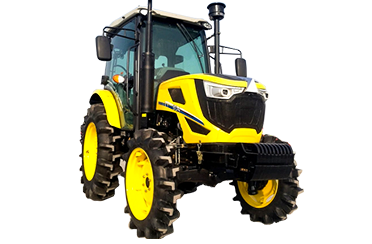
In global cross-border trade, 40HP to 100HP medium-horsepower wheel tractor has become the absolute mainstream export model. Different from high-power heavy tractors suitable for large-scale land reclamation and ultra-compact tractors for greenhouse operations, mid-horsepower wheel tractor is compatible with plowing, sowing, spraying, transportation and other diversified agricultural scenarios, adapting to most small and medium-sized farmland operating environments worldwide.
At present, market demand has shifted from single low-price procurement to high cost-performance procurement. More global farm machinery buyers prefer cost-effective wheel tractor with complete configurations, stable performance and complete after-sales support, rather than low-end simplified models with unstable quality. Both 2WD and 4WD configurations maintain stable export orders, and 4WD wheel tractor is increasingly favored by buyers in hilly, paddy and wetland operation areas due to its strong terrain adaptability.
2.2 Standardized Manufacturing Improves Global Product Competitiveness
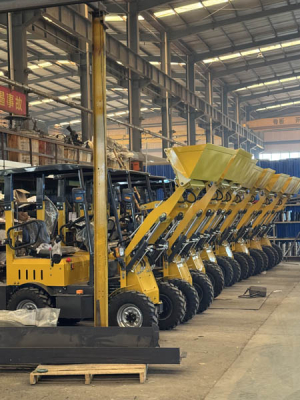
The continuous upgrading of domestic agricultural machinery manufacturing technology is the core support for the rising export volume of wheel tractor. Formal export-oriented manufacturers adopt standardized automated production processes, including high-strength steel frame welding, precision engine assembly, hydraulic system debugging and overall vehicle calibration. Every exported wheel tractor will pass strict factory tests including power detection, hydraulic load test and field simulation operation to ensure that the product meets international use standards.
In terms of certification and configuration optimization, mainstream export models have obtained CE international certification, meeting the access standards of most overseas markets. Meanwhile, manufacturers support personalized configuration adjustments such as tire specifications, chassis height, and cab types according to the needs of different regional markets, solving the problem of single configuration of traditional general-purpose tractors and greatly improving the adaptability of exported wheel tractor in local agricultural production.
2.3 Service-Oriented Export Becomes New Industry Trend
In the past, overseas buyers mainly paid attention to product price and basic performance when purchasing wheel tractor. In 2026, the industry has ushered in a significant change: after-sales service and spare parts supply capacity have become the core evaluation indicators for buyer procurement. Excellent export manufacturers provide complete spare parts packages, multi-language operation manuals and remote technical guidance services, forming a complete set of solutions integrating products and services.
This trend further amplifies the market advantages of cost-effective wheel tractor. While ensuring low procurement costs, standardized supporting services reduce the later operation and maintenance costs for global buyers, effectively improving the long-term return on investment of agricultural machinery equipment.
3. Core Procurement Opportunities for Global Farm Machinery Buyers
The current wheel tractor export market presents unprecedented procurement opportunities for overseas importers and farm operators. First, the diversified supply chain enables buyers to accurately match wheel tractor products according to local land conditions, operation scenarios and power demand, avoiding resource waste caused by mismatched model selection.
Second, the mature manufacturing system greatly reduces the production cost of qualified wheel tractor. Compared with imported high-end brands, standardized export models have the same stable performance and international certification, but have obvious price advantages, becoming the first choice for bulk procurement by global farm machinery buyers.
Third, flexible export order policies support diversified procurement modes. Manufacturers can meet the needs of large-batch container procurement by distributors and small-batch trial order procurement by new market entrants, lowering the threshold for global buyers to enter the agricultural machinery distribution market.
4. Buyer FAQ: Professional Sourcing Q&A
Q1: What core parameters should be prioritized when importing wheel tractor?
A: Buyers should focus on matching horsepower, 2WD/4WD drive mode, hydraulic lifting capacity, PTO speed and engine emission standards. Meanwhile, it is necessary to confirm whether the product has complete international certification and customs clearance documents to ensure smooth market access.
Q2: Is cost-effective wheel tractor suitable for long-term continuous farm operation?
A: Qualified cost-effective wheel tractor with standardized manufacturing and complete configurations can fully adapt to long-term continuous field operations. It is only necessary to avoid selecting simplified low-end models for high-load and high-intensity agricultural work.
Q3: What is the most marketable wheel tractor horsepower for export?
A: 40-100HP mid-horsepower wheel tractor is the most popular export model, suitable for most small and medium-sized farms. Compact models below 40HP are suitable for orchards and greenhouses, while high-horsepower models above 100HP are for large-scale modern farms.
Q4: How to avoid risks when purchasing wheel tractor from overseas manufacturers?
A: Global buyers can verify factory qualifications, product test reports and certification credentials before purchasing. It is recommended to sign clear spare parts supply and after-sales service agreements to effectively reduce procurement and operation risks.
5. Industry Outlook
Driven by global agricultural modernization, the market demand for wheel tractor will maintain sustained and stable growth. In the future, export products will further develop towards intelligence, high efficiency and low energy consumption, and product standardization and service refinement will become the core competitiveness of industry exports. For global farm machinery buyers, the current export market provides high-quality, low-cost and multi-choice procurement channels. Seizing the current export trend opportunities and selecting reliable cost-effective wheel tractor will help global agricultural practitioners reduce production costs and improve overall agricultural production efficiency.