
Bulk Hand‑Push Weeder Export Orders Support Local Orchard Mechanization
Global Market Background for Small‑Scale Orchard Farm Equipment
Labor shortage has become one of the most prominent challenges for fruit planting in developing economies. In many hilly and mountainous orchard zones, large wheel‑type tractors cannot travel freely between narrow tree rows. Traditional manual weeding requires substantial human input, pushing operating costs upward for orchard owners. This market reality creates stable consumption space for lightweight, flexible hand‑push weeder units.
Latest agricultural machinery industry statistics show that the global small orchard machinery market maintains a compound annual growth rate of 6.8% from 2025 to 2032. The orchard application segment accounts for more than 32% of total demand for small power weeding machines. Markets of Southeast Asia, East Africa and South America keep releasing continuous purchasing intentions for hand‑push weeder. As local governments promote agricultural upgrading, bulk weeder export business has expanded rapidly for Chinese manufacturers.
More international distributors gradually recognize the value of lightweight farm machinery. Instead of only purchasing heavy large‑size farm machines, B2B buyers are increasing bulk orders of hand‑push weeder to serve local smallholder fruit farms. The development of orchard mechanization in emerging agricultural markets is strongly relying on this category of compact, affordable working equipment.
Product Specification & Manufacturing Workflow of Export‑Oriented Hand‑Push Weeder
Core Product Structure and Working Parameters
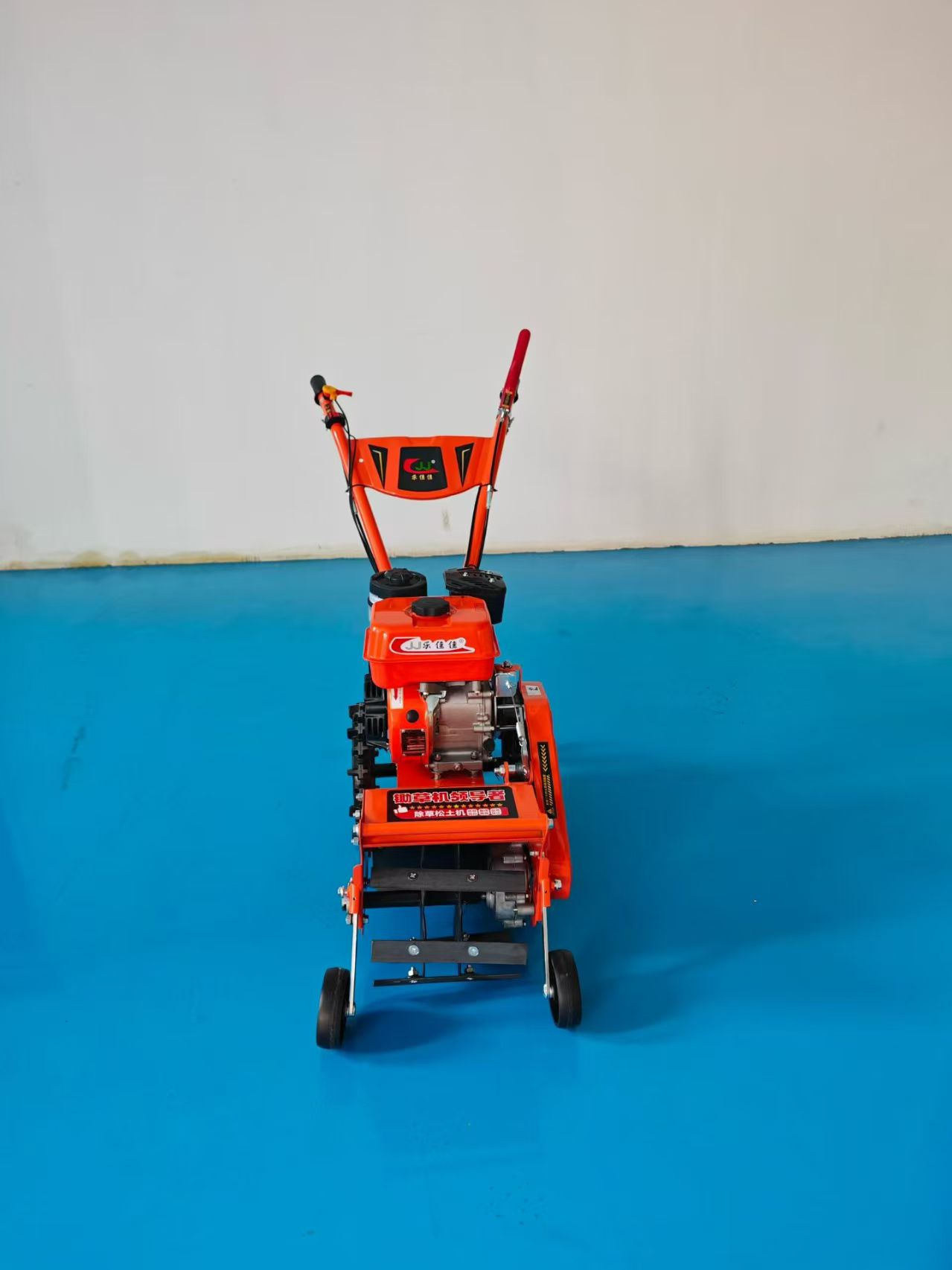
The export‑grade hand‑push weeder is mainly designed for inter‑row weeding, shallow soil loosening and surface tillage inside fruit orchards, tea gardens and hilly small plots. It can effectively remove weeds without seriously damaging shallow root systems of fruit trees.
Key technical specifications for mainstream export models are shown in the following table:
| Power option | 7HP‑9HP gasoline four‑stroke engine |
| Working weeding width | 450‑600 mm adjustable |
| Operating weeding depth | 3‑12 cm adjustable |
| Main frame | Thickened welded steel frame |
| Key working part | Heat‑treated reinforced weeding blade set |
| Net machine weight | 72‑85 kg |
| Operation mode | Hand‑push self‑propelled walking |
Modular design is adopted for this hand‑push weeder. Besides the standard weeding blade assembly, the machine can be fitted with optional ditching blades and shallow tillage attachments. One unit can finish multiple farm jobs including weeding, ditching and soil loosening. The height‑adjustable anti‑vibration hand grip improves operator comfort during long‑hour field operation, an important advantage for daily orchard maintenance work.
Factory Production and Quality‑Control Procedures
Stable quality for bulk weeder export orders is guaranteed by standardized factory manufacturing processes. The whole production starts with CNC cutting for steel frame plates and weeding blades. The reinforced weeding blade goes through dedicated heat‑treatment procedures to improve surface hardness and anti‑abrasion performance. Robot‑assisted welding is applied for main frame welding seams to reduce manual welding defects.
After welding is finished, frame components receive anti‑rust electrophoretic painting. After full machine assembly, each finished hand‑push weeder must complete bench running inspection, engine performance testing and simulated field weeding tests inside the factory. For bulk export batches, random sampling inspection is implemented to verify blade strength, engine stability and handle safety. Before container loading, inspectors check spare‑blade kits, operation manuals and certification documents. Strict off‑line testing helps lower on‑site failure risks after these machines are delivered to overseas orchard farms.
B2B Buyers’ Procurement Preferences and Cross‑Border Procurement Pain Points
Changing Procurement Preferences among Global Machinery Importers
In previous years, many dealers selected hand‑push weeder mainly according to unit price. Currently, as local orchard mechanization moves forward, professional bulk purchasers start to evaluate product durability first. Reinforced weeding blades, reliable engine performance and easy local maintenance have become critical evaluation indicators for bulk weeder export projects.
Most B2B importers for orchard machinery prefer one‑stop procurement solutions. When placing large‑volume orders of hand‑push weeder, they tend to order sufficient spare weeding blades together with main units. Multi‑language operation manuals, after‑sales technical guidance and available CE certification are also frequently requested for regional market access. Many regional dealers hope manufacturers can provide technical training materials for local farm technicians, so that end‑users can carry out routine maintenance independently.
Main Existing Procurement Pain Points for Overseas Buyers
Even though bulk weeder export business keeps growing, cross‑border purchasing of hand‑push weeder still faces several typical industry‑wide obstacles.
First, inconsistent blade quality across different suppliers. Some low‑cost versions of hand‑push weeder adopt ordinary steel without heat‑treatment for weeding blades. After a short period of orchard weeding work, blades bend or wear rapidly, which brings extra replacement costs for orchard farmers. This quality difference is difficult to identify merely from product pictures at the early negotiation phase.
Second, spare‑part supply risks. Several manufacturers only deliver the main machine for bulk orders, without supplying enough consumable spare blades. Once wearing parts break down, local end‑users have to wait for long‑distance international shipments of spare components, delaying seasonal orchard maintenance schedules.
Third, configuration misunderstanding. Some buyers fail to confirm working width and depth adjustment ranges before shipment. When the hand‑push weeder arrives, operators discover that the machine is not suitable for local row spacing of fruit trees. Fourth, logistics constraints. For large‑size bulk weeder export orders, container loading planning needs careful arrangement; packaging protection is essential to avoid frame deformation during sea transportation.
Future Development Trends for Hand‑Push Weeder and Orchard Mechanization
Looking forward to 2026‑2027, the global market for hand‑push weeder will continue to expand together with orchard mechanization in developing countries. Labor‑saving lightweight orchard machinery will remain in strong market demand.
In terms of product iteration, multi‑functional modular configurations will become more popular. New generations of hand‑push weeder will further optimize anti‑vibration handle design and reinforced blade material formulas. Low‑emission gasoline power options will be developed to satisfy stricter environmental requirements in some mature markets. On the service side, forward‑thinking Chinese manufacturers will cooperate with overseas distributors to build local spare‑parts inventory for wearing weeding blades, shortening spare‑part delivery lead‑time for end‑users. Meanwhile, customized machine dimensions will be offered to match different orchard row spacing standards across various countries and regions.
Frequently Asked Questions (FAQ)
Q1: What are the suitable application scenarios for this export‑grade hand‑push weeder?
A: This hand‑push weeder is primarily used for inter‑row weeding and shallow soil loosening inside fruit orchards, tea plantations and hilly small farm plots. It works well on narrow rows where large tractors cannot pass, strongly supporting local orchard mechanization.
Q2: Can buyers order customized working width and extra spare blade kits for bulk weeder export orders?
A: Yes. Manufacturers support customization of working weeding width according to local orchard row spacing. Customers can also add spare reinforced weeding blade kits when submitting bulk orders to facilitate later‑stage local maintenance.
Q3: What certification documents can be supplied for exported hand‑push weeder?
A: Qualified export units can provide CE certification, factory inspection test reports and multi‑language operation & maintenance manuals. Importers should confirm local market access rules before formal ordering.
Q4: What are the common shipping solutions for bulk hand‑push weeder orders?
A: Standard sea container shipping is the mainstream option. For Central Asian inland markets, cross‑border railway transport services are available. Machines are fixed with reinforced packaging inside containers to prevent deformation during transit.
Conclusion & Call to Action
Rising bulk weeder export orders of hand‑push weeder demonstrate that compact lightweight farm machinery is playing an increasingly vital role in global orchard mechanization. With flexible operation performance, reinforced weeding blade assembly and reasonable investment cost, the hand‑push weeder delivers practical labor‑saving solutions for countless small and medium‑size fruit farms across emerging agricultural regions.
For global agricultural machinery dealers, orchard cooperative managers and farm procurement specialists looking for reliable lightweight weeding equipment, please feel free to contact our sales team. You are welcome to request complete technical datasheets, formal quotation documents, real bulk export reference cases and sample consultation. Sufficient early‑stage communication about configuration and spare‑part planning will help you reduce cross‑border procurement risks and bring stable economic benefits for your local orchard clients.