
Chinese Wheel Tractors See Strong Export Growth in 2026
2026/09/21 14:03
1. Global Agricultural Machinery Market Background
Global food security strategies and continuous rural modernization construction have steadily boosted market demand for professional farming equipment, especially versatile and cost-efficient wheel tractor units. In 2026, emerging economies in Central Asia, Southeast Asia, South America and sub-Saharan Africa remain the main consumption markets for global wheel tractor products, while Eastern European and Middle Eastern markets show steady replacement demand for outdated agricultural machinery.
Industry global agricultural machinery statistics indicate that the international wheel tractor market maintains a stable compound annual growth rate, with small and medium horsepower wheel tractor products occupying the mainstream market share. Compared with high-priced European and American branded equipment, Chinese wheel tractor solutions deliver balanced performance, flexible configuration and competitive pricing, forming prominent market advantages in global bulk procurement and small-scale farm renovation projects. This fundamental market gap lays a solid foundation for continuous wheel tractor export growth in 2026.
With the acceleration of cross-border trade liberalization and mature international logistics systems, Chinese wheel tractor manufacturers have further expanded overseas sales channels, covering dealer wholesale, government agricultural procurement and large farm customized orders. The overall wheel tractor export scale continues to expand, marking the formal maturity of China’s medium and high-end agricultural machinery export system.
2. 2026 Wheel Tractor Export Core Market Data & Product Structure
2.1 Official Export Growth Data
According to China customs foreign trade monitoring data, the overall export volume of Chinese wheel tractors achieved a year-on-year increase of 32.6% in the first half of 2026, and the export growth rate continues to rank among the top categories of national agricultural machinery exports. In terms of export value, medium and high-power wheel tractor products above 100HP contribute more than 58% of the total export value, becoming the core profit growth point of wheel tractor export business.
Regionally, Central Asian countries remain the largest trading partners for Chinese wheel tractor exports, with stable batch orders throughout the year. South American markets including Brazil and Argentina achieved a 117% year-on-year surge in import volume of Chinese wheel tractors, driven by large-scale grain cultivation mechanization upgrades. African regional markets maintain rigid demand for compact wheel tractor equipment for smallholder farm operations.
2.2 Mainstream Export Product Technical Parameters & Classification
The 2026 wheel tractor export market presents an obvious segmented development trend, with two mainstream product segments dominating overseas orders, covering all mainstream farming scenarios:
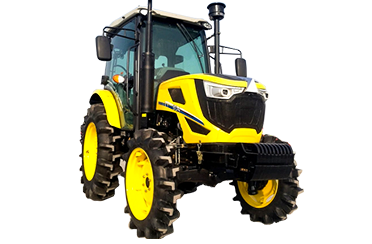
Compact Wheel Tractor (25HP–40HP): This series is the most exported lightweight model, equipped with energy-saving diesel engines, flexible 4WD drive systems and narrow chassis design. Featuring a small turning radius, high ground clearance and strong terrain adaptability, it is widely used in orchard management, hilly land tillage and small plot crop planting. The supporting hydraulic lifting system and universal PTO interface can match various small agricultural implements, fully meeting the refined operation needs of overseas small-scale farmers.
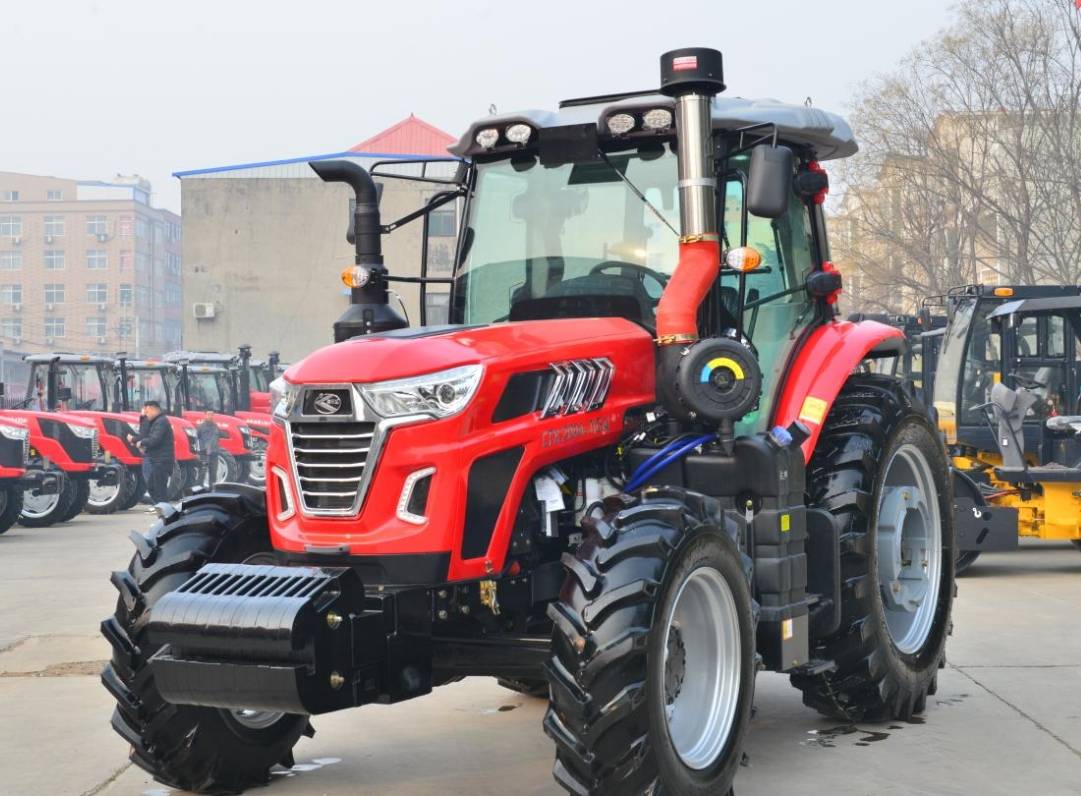
Medium and High-Power Wheel Tractor (100HP–180HP): As the fastest-growing export segment in 2026, this series adopts 6-cylinder turbocharged intercooled engines, matched with 12F+12R or 28F+8R multi-speed shuttle transmissions. Equipped with dual hydraulic output ports and 540/760rpm dual-speed PTO, the equipment supports heavy-duty plowing, deep tillage, sowing and large-area land consolidation operations. Optional configurations including ROPS rollover protection system, air-conditioned enclosed cab and satellite precision navigation system further improve operational safety and farming efficiency.
High-power wheel tractor products above 200HP are still in the stage of overseas market layout. Chinese manufacturers continue to optimize heavy-duty chassis structure and intelligent control systems, gradually breaking the monopoly of Western brands in the high-end large farm equipment market.
2.3 Manufacturing & Quality Control Optimization for Export Standards
The sustained wheel tractors export growth in 2026 is inseparable from the comprehensive upgrading of domestic manufacturing processes. Formal export-oriented wheel tractor production follows standardized whole-process quality management, including precision machining of core engine and transmission components, automatic robot welding of chassis, multi-layer anti-corrosion electrophoretic painting, hydraulic system pressure testing and factory field simulation operation testing.
All export wheel tractor units implement exclusive overseas inspection standards. Key components such as drive axles, clutch assemblies and hydraulic pumps undergo fatigue sampling tests. Before container loading, inspectors will verify safety protection devices, sealing performance, instrument accuracy and complete product certification files one by one to ensure that all delivered wheel tractor products meet the access standards of destination countries.
3. International B2B Buyer Procurement Preferences & Core Pain Points
3.1 Current Mainstream Buyer Preferences
With the continuous iteration of the wheel tractor export market, overseas professional dealers and farm end-users have formed more standardized and refined procurement preferences. Cost performance is no longer the only consideration; buyers pay more attention to product adaptability, supporting services and long-term operational stability.
Customized configuration has become a basic demand for bulk orders. Buyers will independently choose open-type or enclosed cab, anti-skid tires suitable for local terrain, extended hydraulic valves and supporting front-end loader accessories according to regional farming habits. In addition, complete after-sales support systems have become a key factor in order competition. Overseas importers prefer manufacturers that can provide centralized spare parts supply, multi-language technical manuals and regular remote maintenance guidance.
3.2 Typical Procurement Pain Points in Wheel Tractor Export
Despite the booming wheel tractor export growth in 2026, the cross-border procurement process still has industry-wide pain points that restrict long-term cooperation. First, the overseas after-sales service network is uneven. Some small manufacturers only focus on delivery efficiency and lack overseas spare parts warehouses, resulting in long equipment maintenance cycles and affecting end-user farming progress.
Second, product specification information is asymmetric. Wheel tractor products with the same horsepower parameters from different manufacturers may have differences in core components, transmission systems and load capacity. Unconfirmed detailed parameters in the early stage easily lead to product mismatch with local operation scenarios after delivery.
Third, regional certification compliance risks exist. Wheel tractor products exported to Europe, North America and other regions need to meet strict CE, ROPS and emission certification standards. Uncertified equipment will face customs detention and market access failure risks. Fourth, large-size wheel tractor equipment is limited by container specifications, requiring bulk cargo shipping, which increases overall procurement logistics costs.
4. 2026–2027 Wheel Tractor Export Industry Development Trends
Looking ahead, the global wheel tractor export industry will shift from price competition to technology and service competition. Intelligent upgrading will become the core development direction of Chinese wheel tractor products. More export models will be pre-installed with precision farming interfaces, supporting automatic steering, land leveling and intelligent operation monitoring to adapt to the global precision agricultural development trend.
In terms of energy conservation and environmental protection, hybrid power and low-emission wheel tractor R&D investment will continue to increase, helping Chinese products meet the higher environmental access standards of mature overseas markets. At the same time, manufacturers will accelerate the construction of overseas localized service systems, build regional spare parts warehouses and provide localized technical training, effectively solving the after-sales pain points of cross-border procurement.
Market segmentation will be further refined. Specialized wheel tractor products for orchards, hilly lands, saline-alkali lands and large-scale commercial farms will continue to enrich the product matrix, realizing precise matching with differentiated global market demand and maintaining the sustained growth momentum of wheel tractor export.
5. Frequently Asked Questions (FAQ)
Q1: Which wheel tractor models are the most popular for Chinese exports in 2026?
A: Compact 25–40HP wheel tractors for smallholder farms and 100–180HP 4WD medium and high-power wheel tractors for large-scale farm operations are the two best-selling categories, covering mainstream demand in Asia, Africa and South American markets.
Q2: What certifications do exported Chinese wheel tractors usually support?
A: Qualified export wheel tractors support CE certification, ROPS safety certification and international emission standard certification. Manufacturers can provide targeted certification documents according to the regulatory requirements of the buyer’s destination country to ensure smooth customs clearance and market access.
Q3: Can Chinese manufacturers provide customized wheel tractor solutions?
A: Yes. Professional export manufacturers support full-link customization including cab configuration, tire specification, hydraulic system expansion, supporting agricultural implements and engine emission standards, adapting to diverse local farming environments and policy requirements worldwide.
Q4: What are the mainstream shipping methods for bulk wheel tractor export orders?
A: Small and medium-sized wheel tractors adopt containerized shipping after partial disassembly. Large high-power wheel tractor equipment uses ro-ro shipping or bulk cargo transportation. For Central Asian inland markets, professional cross-border rail freight services are available.
6. Conclusion & Call to Action
The strong wheel tractors export growth achieved by Chinese manufacturers in 2026 fully proves that Chinese wheel tractor products have completed the transformation from low-cost advantage to comprehensive strength advantage including technology, quality and service. With continuous product upgrading and service system improvement, Chinese wheel tractors will further expand global market share and become a core choice for global agricultural mechanization construction.
For global agricultural machinery dealers, farm cooperative managers and large-scale farm operators seeking high-quality wheel tractor equipment, professional customized solutions and reliable cross-border after-sales services, please contact our team to obtain detailed technical datasheets, official quotation lists, real export case materials and sample testing support. Professional one-stop procurement guidance helps you select the most suitable wheel tractor model to reduce procurement risks and maximize project benefits.