
New Diesel Riding Crawler Rotary Tiller Delivers Stable Power for Tough Soil
2026/09/21 14:36
Global Market Background for Specialized Small-Scale Farm Machinery
Across the world, the mechanization of hilly, mountainous and orchard farmland has become one major development direction for modern agriculture. Many small and fragmented farm plots in Southeast Asia, South America, and parts of Africa cannot deploy large wheel-type tractors effectively. Heavy wheeled farm vehicles easily cause soil compaction on sloped land, leaving local farmers searching for compact yet powerful alternatives for tough-soil tillage.
Market research data shows the global riding crawler rotary tiller market maintains a compound annual growth rate of 6.22% from 2025 to 2032. Rising awareness of farm tillage efficiency pushes dealers and farm cooperatives to invest in terrain-adaptable crawler farming equipment. Traditional walk-behind tillers demand heavy manual labor, while large tractors lack flexibility on narrow terraced fields. This market gap creates solid commercial space for the upgraded diesel riding crawler rotary tiller.
Many international agricultural importers are shifting their procurement focus from general-purpose farm machines to scenario-specialized models. As hilly-region grain and fruit planting continues expanding, overseas orders for riding crawler rotary tillers keep rising year after year. Chinese manufacturers have gradually built competitive advantages in this product segment, combining reasonable pricing with continuous technical iteration to satisfy diversified global farming requirements.
Market Demand & Key Technical Specifications of New Diesel Riding Crawler Rotary Tiller
Current Market Segmentation and Application Scenarios
The riding crawler rotary tiller market can be divided mainly by engine power grade. 25HP-35HP diesel models occupy the largest share of overseas export volume. This power range targets orchard soil loosening, terraced field preparation, dry-land tough-soil tillage and light paddy field operations. Higher-power variants above 45HP are mostly used for heavy clay land and consolidated soil where deep tillage work is required.
Different regional markets show distinct preferences. Buyers in Southeast Asian hilly territories prioritize amphibious performance for alternating dry and muddy plots. Importers from Latin America focus more on engine torque output to break hard compacted topsoil. African smallholder farms value simple maintenance and strong adaptability under harsh field conditions. All these market signals drive manufacturers to refine the new diesel riding crawler rotary tiller for complicated working environments.
Core Technical Parameters & Product Structure
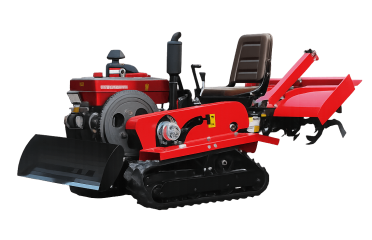
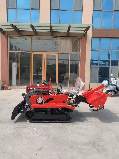
This new diesel riding crawler rotary tiller adopts a water-cooled heavy-duty diesel engine as its power source, delivering continuous stable torque output during tough-soil tillage. The reinforced crawler chassis uses steel-wire embedded rubber tracks, which lowers ground pressure to reduce soil compaction while enhancing grip on slopes and uneven ground.
Major technical indicators of this upgraded model are listed below. Working tilling width ranges from 1100 mm to 1300 mm, with adjustable tilling depth between 12 cm-22 cm. The rotary tiller blade set is made of wear-resistant alloy steel to resist abrasion when cutting hard clods. The operator sits on a comfortable riding seat with lever-style steering control; zero-radius turning enables flexible movement within narrow orchard rows. Multiple quick-change attachment interfaces are reserved, so farmers can swap between rotary tilling blades, ditching blades and bulldozer blades on one single machine to improve overall farm tillage efficiency.
Parameter | Specification |
|---|---|
Engine Type | Water-cooled heavy-duty diesel, 25HP–35HP (standard) / 40HP–48HP (upgraded) |
Working Width | 1100 mm – 1300 mm (adjustable) |
Tilling Depth | 12 cm – 22 cm (adjustable) |
Crawler Track | Steel-wire embedded rubber track, reinforced chassis |
Turning Radius | Zero-radius (pivot steer) |
Attachment Compatibility | Rotary blades, ditching blades, bulldozer blades, weeding tools |
Manufacturing and Factory Quality-Control Workflow
Consistent performance of the new riding crawler rotary tiller relies on standardized domestic production procedures. The whole manufacturing process starts with thick steel plate cutting and robot chassis welding. After welding work is finished, components go through electrophoretic anti-corrosion painting treatment to resist rust under humid farm working conditions.
Engine, gearbox and crawler assembly are finished on dedicated assembly lines. Every finished riding crawler rotary tiller must pass bench testing of transmission and hydraulic systems. Factory field simulation tests will verify actual tough-soil tillage performance before packaging. For export-bound units, inspection staff double-check safety guards, emergency stop functions and complete technical documentation. Strict off-line testing helps reduce on-site breakdown risks after the machine arrives at overseas farms.
International B2B Buyers' Procurement Preferences & Existing Pain Points
Changing Preferences among Global Importers
In the past, many buyers selected riding crawler rotary tillers purely based on low price. Nowadays, professional dealers pay far more attention to actual field performance, especially stable power output during tough-soil tillage. Compatibility with local farming attachments has become another key selection criterion. Importers hope one machine can finish multiple jobs including tilling, ditching and soil leveling, to lower farmers' total equipment investment.
Complete spare-parts supply and accessible maintenance guidance are increasingly important for bulk purchasers. Many B2B customers prefer manufacturers who can supply multi-language service manuals and provide consolidated spare-parts shipments together with main-unit orders. Some large importers also request optional CE safety certification for regional market access.
Main Procurement Pain Points for Overseas Purchasers
Even with growing market demand for riding crawler rotary tillers, cross-border purchasing still brings several well-known challenges for international buyers.
First, inconsistent actual working performance across similar-looking machines. Two riding crawler rotary tillers with identical horsepower marking may be fitted with different engine brands or different hardness grades of rotary blades. When the machine enters tough-soil tillage work, insufficient torque will lead to frequent stalling and lower farm tillage efficiency. Without detailed technical confirmation in early negotiation stages, end-users will face disappointing field results.
Second, after-sales spare-part shortages. Many small suppliers only deliver finished machines without establishing stable spare-part supply pipelines. Once key wearing parts such as rotary tiller blades or crawler rubber segments break, local dealers need to wait a very long time for replacement parts, delaying seasonal farm work.
Third, certification confusion. Some low-spec versions of riding crawler rotary tillers do not hold CE documents. If importers fail to verify certification in advance, shipments may encounter customs hold-up upon arrival at destination ports. Fourth, logistics constraints. Due to irregular machine shape, container loading requires careful disassembly and fixed packaging, which affects overall logistics cost.
Future Development Trends for Riding Crawler Rotary Tiller Industry
Looking forward from 2026 onward, the riding crawler rotary tiller industry will continue moving toward stronger power, multi-function configuration and localized adaptation. For tough-soil tillage scenarios, manufacturers will further optimize engine-transmission matching, to keep stable torque output under heavy load without sharp increases in fuel consumption.
Modular design will become mainstream. More riding crawler rotary tiller models will support fast swapping of working attachments to satisfy orchard, terrace, dry-land and paddy-field requirements. Meanwhile, low-emission diesel engine upgrades will help Chinese-made units satisfy stricter environmental standards for European and other mature markets. Service competition will gradually replace simple price competition; forward-thinking suppliers will cooperate with overseas dealers to build regional spare-parts inventory and organize local technician training, effectively solving after-sales bottlenecks for global users.
Frequently Asked Questions (FAQ)
Q1: What is the most suitable horsepower range of riding crawler rotary tiller for tough-soil tillage?
A: For most heavy compacted dry farmland, the 25HP-35HP diesel riding crawler rotary tiller is the preferred option. For extra-hard clay soil plots, buyers can select upgraded 40-48HP variants to guarantee stable power output during continuous heavy-load tilling.
Q2: Which attachments can be matched with this new diesel riding crawler rotary tiller?
A: The machine supports rotary tiller blades, ditching blades, bulldozer blades and weeding tools. Different working implements can be installed quickly according to local farm operations to raise farm tillage efficiency.
Q3: What certification documents can Chinese export-model riding crawler rotary tillers provide?
A: Qualified export units can provide CE certification, factory inspection reports and multi-language operation & maintenance manuals. Buyers should clarify local market access requirements and confirm relevant documents before formal ordering.
Q4: What are common shipping solutions for bulk orders of riding crawler rotary tillers?
A: Small-sized units can be partially disassembled and loaded inside standard sea containers. Larger heavy-duty models can adopt ro-ro vessel shipment. For inland Central Asian destinations, cross-border railway transport is available.
Conclusion & Call to Action
The launch of the new diesel riding crawler rotary tiller delivers a practical solution for global farmers struggling with tough-soil tillage on hilly and fragmented farmland. Stable diesel power output, reinforced crawler chassis and multi-implement compatibility help improve farm tillage efficiency for small-to-medium scale agricultural operations worldwide.
For B2B agricultural machinery dealers, farm cooperative managers and farming contractors seeking reliable crawler-type tillage equipment, you are welcome to get in touch with our team to request detailed technical datasheets, formal quotation sheets, real overseas reference cases, and sample consultation. Early technical communication will help you select proper specifications, reduce procurement risks, and create better benefits for local farming clients.