
Global Rotary Tiller Demand Evolves Fast
2026/09/09 08:42
1. Global Agricultural Industry Background and Latest Market Data
The global agricultural industry is undergoing comprehensive mechanization transformation, which has become the core driving force for the steady expansion of the tillage equipment market. In recent years, the continuous rise of rural labor costs and the growing demand for crop yield improvement have forced small and medium-sized farms and large commercial planting bases worldwide to phase out traditional manual tillage and scattered mechanical operations, and adopt efficient, integrated rotary tiller equipment for seedbed preparation, soil loosening and crop residue treatment.
Industry authoritative research data shows that the global rotary tiller market scale reached US$2.29 billion in 2025. Benefiting from the continuous penetration of agricultural mechanization in emerging markets and the replacement demand of stock equipment in developed markets, the market is expected to maintain a compound annual growth rate of 6.2% from 2026 to 2034, with the total market value breaking US$3.93 billion by the end of the forecast period.
In terms of regional market distribution, the Asia-Pacific region dominates the global market share, contributing 38% of the global rotary tiller market revenue in 2026, followed by North America and Europe. Policy support for green and precision agriculture in European and American countries has accelerated the upgrading of low-energy-consuming and high-intelligent tillage equipment. The global market demand for rotary tiller shows obvious regional differentiation: South and Southeast Asian markets focus on low-cost compact mechanized equipment, while Latin America, Africa and other emerging agricultural regions prefer multi-functional and high-adaptability tillage equipment. Developed markets have higher requirements for equipment energy saving, emission reduction and intelligent configuration.
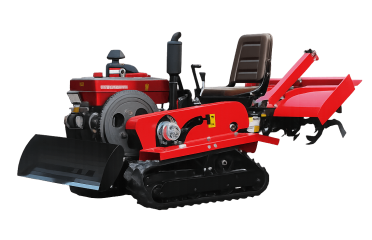
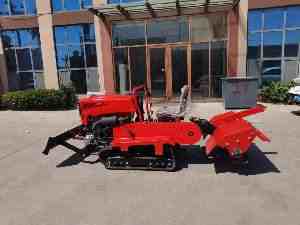
As a high-growth subdivision of tillage equipment, riding crawler rotary tiller has achieved rapid market growth in the past three years. Different from traditional wheeled rotary tiller, this equipment is adapted to complex working conditions such as hilly orchards, terraced fields, paddy fields and narrow greenhouse operations, solving the pain points of easy slipping and sinking of traditional equipment in special terrain, and has become a key product favored by global professional farm contractors.
2. In-depth Analysis of Global Rotary Tiller Market Development Trends
2.1 Mainstream Market Development Shifts
The global rotary tiller market has formed three obvious development trends in recent years. Firstly, multi-functional integration has become the core product iteration direction. International buyers no longer pursue single tillage function, but prefer equipment with modular design, which can be matched with ditching, ridging, weeding and backfilling accessories to realize multi-scene operation. The modular structure design of riding crawler rotary tiller perfectly meets the diversified operation needs of modern farms and greatly improves the utilization rate of single equipment.
Secondly, the market competition focus has shifted from low upfront price to full-life-cycle cost performance. Global bulk buyers and equipment leasing companies pay more attention to equipment durability, fuel consumption performance, spare parts universality and later maintenance cost. Low-quality rotary tiller with frequent gearbox failures and rapid blade wear is gradually eliminated from the mainstream market, and high-quality and stable products have become the first choice for long-term cooperative buyers.
Thirdly, environmental protection and humanized operation have become rigid industry thresholds. The European and American markets have clearly put forward emission standard requirements for agricultural machinery power systems, while the hilly and mountainous operation scenarios in emerging markets require equipment to have shock absorption, comfortable operation and simple control functions to adapt to long-hour continuous operation.
2.2 Differentiated Regional Market Trends
There are obvious differences in product demand between developed and emerging agricultural markets. Developed regions such as Europe and North America focus on intelligent upgraded rotary tiller, supporting precision operation functions such as depth sensing and operation data recording to match the development of modern precision agriculture. Emerging markets in Asia, Africa and Latin America take practicality and economy as the core demand, favoring rotary tiller with simple structure, convenient on-site maintenance and low failure rate, and do not pursue excessive intelligent configuration. This market differentiation promotes manufacturers to form a dual product system of high-end intelligent models and cost-effective practical models.
3. Core Technical Parameters and Standard Product Structure
3.1 Key Technical Parameters of Mainstream Models
At present, the mainstream rotary tiller products in the global market cover a complete power range, including small hand-push models below 12HP and large tractor-mounted heavy-duty models above 70HP. Among them, the mainstream specification of riding crawler rotary tiller popular in the global special terrain market is 25HP to 35HP rated power, with adjustable tillage width of 1000mm to 1200mm and tillage depth of 80mm to 180mm. The standard operation efficiency is 0.3 to 0.5 hectares per hour, which can be adjusted according to soil hardness and humidity.
In terms of core operation parameters, the rotor speed of mainstream rotary tiller is controlled between 280rpm and 370rpm. The crawler chassis of riding crawler rotary tiller effectively reduces ground pressure, avoiding sinking and compaction in muddy paddy fields. The comprehensive fuel consumption is controlled below 17.6kg per hectare, with excellent energy-saving performance. In terms of blade matching, L-type blades occupy 65% of the market share, suitable for conventional dry land tillage; C-type curved blades are widely used in paddy fields and residual crop fields, which can effectively reduce grass winding and improve soil crushing uniformity.
3.2 Standard Product Structure Composition
The standardized rotary tiller is composed of four core parts: frame structure, power transmission system, rotary tillage working assembly and depth adjustment mechanism. First, the main frame is made of Q355 high-strength steel integral welding, with strong load-bearing and anti-deformation ability; the riding crawler rotary tiller adopts rubber crawler chassis instead of traditional wheeled structure, which greatly improves the stability of slope operation and terrain adaptability.
Second, the power transmission system adopts alloy forged gears and heat treatment process, which can withstand long-term heavy-load operation, effectively reducing gear wear and gearbox oil leakage failure. Third, the rotary tillage working assembly adopts spiral arranged blade shaft structure, which balances cutting resistance, reduces operation vibration and ensures uniform soil crushing. Fourth, the auxiliary system includes safety protective cover, hydraulic depth adjustment device, operation console and multi-functional quick-change accessories, which supports diversified farmland operation needs.
4. Standard Manufacturing Process and Actual Field Application
4.1 Industrial Standard Manufacturing Process
Formal rotary tiller manufacturers implement standardized and refined production processes to ensure product consistency and stability. The whole production process includes raw material inspection, precision processing, welding forming, heat treatment, assembly debugging and factory testing. All raw materials such as steel plates and gear blanks are strictly inspected for material performance to meet international agricultural machinery production standards.
Key wearing parts such as tillage blades are made of 65Mn spring steel and 50CrV4 alloy steel, after forging, quenching and tempering treatment, the hardness reaches HRC 50-55, which greatly extends the service life. The gearbox assembly will undergo bench running test to detect noise, temperature rise and sealing performance. In the final assembly link, all bolts are tightened with standardized torque, and anti-loosening and sealing treatments are carried out for vibration-prone parts. Each finished rotary tiller will pass no-load test and simulated load operation test before leaving the factory to ensure zero failure rate of core functions.
4.2 Farmland Operation Application Process
Rotary tiller is the core equipment for farmland seedbed preparation, covering the whole process of soil loosening, crushing and residue mixing. Before operation, operators need to adjust the tillage depth through the tail skid, check the blade fastening state and gearbox oil level. During operation, the high-speed rotating blades complete soil cutting and crushing in one pass, forming loose and flat soil suitable for sowing.
In complex terrain scenarios such as hills, terraces and paddy fields, riding crawler rotary tiller shows irreplaceable application advantages. The rubber crawler ensures stable traction on wet and soft soil and sloped land, avoiding the sinking and soil damage problems of traditional wheeled tillage equipment. Meanwhile, the quick-change accessory function enables the equipment to switch between tillage, ditching and weeding operations freely, effectively improving the annual utilization rate of the equipment and bringing higher economic benefits to farmers.
5. International Buyers’ Procurement Preferences and Core Pain Points
5.1 Main Procurement Preferences of Global Buyers
Through sorting out global B2B procurement data, international rotary tiller buyers have formed clear and unified selection preferences. Agricultural machinery distributors pay attention to standardized product series, stable batch quality, complete certification documents and flexible mixed container loading schemes, which facilitate market sales and inventory management. Farm contractors and large planting bases focus more on equipment practicability, requiring low fuel consumption, convenient maintenance and complete local spare parts supply channels.
For special terrain operation markets such as mountains and wetlands, buyers take riding crawler rotary tiller as the preferred procurement model due to its strong terrain adaptability. In addition, most professional B2B buyers will require suppliers to provide complete technical documents, including parameter sheets, dimension drawings, spare parts catalogs and operation maintenance videos, and verify product performance through actual farmland operation cases before bulk procurement.
5.2 Core Procurement Pain Points in Global Sourcing
At present, international buyers face four major pain points in the process of sourcing rotary tiller. First, product batch quality is unstable. Many low-cost generic products have common problems such as loose blades and gearbox oil leakage, which are prone to failure in the critical farming season and cause serious economic losses.
Second, the supply of spare parts is inefficient. Most small and medium-sized suppliers lack overseas warehousing layout, and the replacement of wearing parts such as blades and bearings requires long-distance transportation, resulting in prolonged equipment downtime. Third, product parameters cannot adapt to local soil conditions. Standard general-purpose rotary tiller cannot be adapted according to local clay, rocky soil and paddy field environments, resulting in poor operation effect.
Fourth, the delivery cycle is unstable. Agricultural machinery procurement has strong seasonal attributes. Unpredictable delivery delays will cause buyers to miss the best sales and operation season, directly affecting market revenue.
6. Professional FAQ for Global Rotary Tiller Sourcing
Q1: What is the difference between rotary tiller and rotavator in global trade?
A: The two terms refer to the same agricultural tillage equipment. Rotavator is mostly used in South Asian regional markets, while rotary tiller is the unified standard term for global B2B trade, European and American markets and industry official documents.
Q2: Can riding crawler rotary tiller adapt to both dry land and paddy field operations?
A: Yes. The low-pressure rubber crawler chassis can effectively avoid sinking in wet paddy fields, and it also performs stably in dry hilly orchards and terraced fields. It is only necessary to match different blade types and adjust tillage depth according to soil conditions.
Q3: How to effectively reduce the long-term maintenance cost of rotary tiller?
A: It is recommended to select products with heat-treated alloy blades and high-quality gearbox accessories, regularly replace gear lubricating oil, check blade fasteners regularly, and establish a local spare parts inventory. Buyers can request suppliers to provide complete wearing parts lists for daily maintenance.
Q4: What qualification documents are required for bulk rotary tiller procurement?
A: Formal bulk procurement requires technical parameter sheets, product dimension drawings, material test reports, industry certification documents, spare parts catalogs, operation and maintenance manuals, and actual field operation case reports.
7. Call to Action
Whether you are a global agricultural machinery distributor, professional farm contractor or large-scale plantation operator, if you are looking for high-quality, stable-performance rotary tiller and customized riding crawler rotary tiller solutions, please contact our professional team immediately. We provide official full-version technical data sheets, targeted personalized quotations, complete after-sales spare parts packages and containerized overall shipping solutions. Submit your demand now to obtain exclusive procurement guidance and industry case resources matching your regional market.