
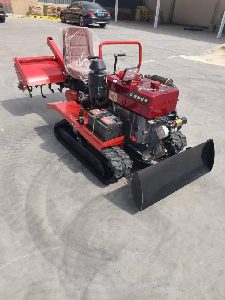
Riding Crawler Rotary Tiller for Tough Farmland
Global Farm Mechanization Faces Obstacles from Tough Farmland Conditions
Agricultural mechanization continues expanding across emerging agricultural regions, yet tough farmland remains one of the biggest barriers for small‑to‑medium farm operators, agricultural contractors and machinery importers worldwide. Tough farmland covers hilly slopes, sticky muddy paddies, compacted clay soil and uneven fragmented plots, where ordinary wheel‑type farm equipment often suffers slipping, sinking and poor tillage performance. Industry analysis shows that the global crawler rotary tiller market maintains steady growth at a CAGR of 5.2%‑6.2% in the 2026‑2034 forecast period, driven by rising demand for machinery capable of working on difficult terrain.
Traditional walking‑behind tillers demand heavy manual labor, while wheeled tractors frequently get stuck in wet mud or lose stability on slopes. More international B2B buyers searching riding crawler rotary tiller for sale prioritize terrain adaptability over basic price points. For importers and fleet owners, equipment that cannot operate reliably on tough farmland will directly delay planting schedules and raise overall production costs. This market shift makes the riding crawler rotary tiller a highly sought‑after solution for challenging agricultural environments across Southeast Asia, Africa, Latin America and mountainous farming zones.
Many overseas buyers report that standard tillage tools can finish soil preparation smoothly on flat dry fields, but efficiency drops sharply once they enter muddy paddies, hilly terraces and hard compacted soil. Therefore, manufacturers keep optimizing the riding crawler rotary tiller to resolve real‑world pain points generated by tough farmland, balancing stable performance, operator comfort and flexible multi‑scene adaptability.
Core Technical Advantages of Riding Crawler Rotary Tiller for Tough Farmland
Reinforced Crawler Chassis Delivers Superior Terrain Pass‑through
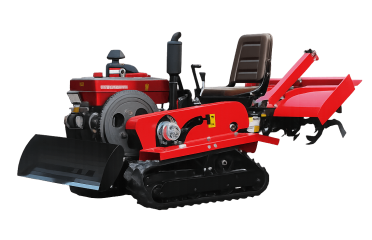
The crawler chassis constitutes the core competitive edge when a riding crawler rotary tiller works on tough farmland. Compared with wheeled farm machines, the wide‑contact crawler structure effectively lowers ground pressure, greatly reducing sinking risks on muddy, water‑logged paddy soil. Optimized chassis clearance further improves anti‑sinking capacity when moving across deep‑mud farmland, allowing stable travel on inclined hilly plots without slipping or tilting risks.
High‑strength rubber tracks fit most working scenarios; reinforced track frames resist deformation under long‑hour vibration from hard‑soil tillage. The whole chassis undergoes stress‑relief treatment during manufacturing, to extend service life under continuous impact from tough farmland conditions. Such structural design enables the riding crawler rotary tiller to keep consistent travelling performance on terrains where conventional wheeled farm equipment cannot work normally.
Power Assembly and Rotary Tilling Unit Optimized for Complex Soil
To handle compacted soil, hard clods and mixed root residues on tough farmland, the riding crawler rotary tiller is equipped with high‑torque diesel power matched with optimized transmission modules. Power output delivers sufficient torque for breaking hard soil clumps without frequent engine overload. Hardened alloy rotary blades cut, crush and mix soil efficiently; blade angles are fine‑tuned to achieve ideal tilling depth even in sticky clay ground.
Operators can adjust tilling depth according to local soil conditions. On muddy paddy plots, the riding crawler rotary tiller completes puddling work; on hilly dry farmland, it breaks compacted topsoil for seedbed preparation. The seated operation design lessens operator fatigue significantly compared with hand‑held tillers, supporting longer continuous working shifts on remote tough farmland sites.
Manufacturing Process and Typical Application Scenarios
During production, every riding crawler rotary tiller goes through standardized manufacturing workflows. Key frame components are cut and robot‑welded, followed by stress‑relief processing to eliminate internal welding stress. After assembling engine, crawler chassis, transmission system and rotary tillage components, each unit completes simulated running‑in tests under load conditions. Engineers simulate muddy, sloped and hard‑soil working states to check power output, track stability and rotary tiller operation before product shipment. Quality inspection covers every core component, ensuring stable performance when the machine arrives at overseas tough farmland.
In practical deployment, the riding crawler rotary tiller undertakes diverse assignments. On hilly terraced fields, it carries out soil preparation for grain and vegetable planting. In low‑lying paddy zones, it performs puddling and soil leveling. It also works in orchards with uneven ground, completing inter‑row loosening and weeding tasks. For global importers looking for riding crawler rotary tiller for sale, matching power grade, track width and blade configuration with local soil and terrain features helps maximize working returns on tough farmland.
Current Market Trends for Global Crawler‑Type Farm Equipment Procurement
Several clear trends are reshaping international purchasing of riding crawler rotary tiller. First, buyers increasingly evaluate total cost of ownership rather than only comparing initial purchase price. Equipment with strong reliability and accessible spare‑part supply gains more market share, as unexpected breakdowns on remote tough farmland can halt the whole planting cycle. Second, multi‑function capability becomes a critical selection index. Modern units support quick replacement of attachments for tilling, ditching and ridging, helping farm operators reduce investment in separate single‑purpose machines. Third, customized solutions grow popular; manufacturers provide different engine emission versions to satisfy regional certification requirements for cross‑border importers searching riding crawler rotary tiller for sale.
Regional demand differs obviously. Tropical and subtropical agricultural markets show strong demand for models adapted to muddy paddy fields. Mountain farming regions prioritize slope stability and compact body dimensions for narrow terraced plots. As small‑holder farm mechanization speeds up, the riding crawler rotary tiller will keep expanding its market coverage across multiple developing agricultural regions.
Frequently Asked Questions from International B2B Buyers
Q1: What terrain types can this riding crawler rotary tiller handle on tough farmland?
A: It is well‑suited for muddy paddy fields, hilly sloped terraces, compacted clay soil, orchards and irregular fragmented plots. It performs excellently on wet and soft soil where wheeled machines get stuck. For extremely steep slopes over 15 degrees, please select low‑speed operation mode for safety.
Q2: What key specifications should I check before ordering riding crawler rotary tiller for sale?
A: Focus on engine power, tilling depth and width, track width, ground clearance, blade material and emission compliance. Confirm whether spare‑part supply can support your local after‑sales service. Share your local soil type, main crop types and average working hours per day to get suitable configuration suggestions.
Q3: What is the routine maintenance cycle for the riding crawler rotary tiller operating on tough farmland?
A: Under normal working conditions on tough farmland, complete routine maintenance every 100‑150 operating hours. Key items include track tension inspection, rotary blade wear check, engine oil replacement and cleaning of soil residues on transmission parts. Consumable parts such as blades and track rubber blocks need periodic replacement according to actual wear status.
Q4: Can I get customized configurations for bulk orders?
A: Yes. Customizable options include engine emission standards, different rotary blades, auxiliary attachments for ditching or ridging, and protective reinforcements for heavy‑duty muddy‑field operations. Bulk purchasing can negotiate warranty terms, spare‑part packages and shipment terms.
Conclusion
Against the background of global agricultural mechanization progress, the riding crawler rotary tiller provides a practical solution for challenging tough farmland environments. Benefiting from optimized crawler chassis, high‑torque power system and reinforced tillage components, this machine overcomes many typical limitations of traditional farm equipment on muddy, hilly and compacted farmland. For B2B importers, farm contractors and distributors searching riding crawler rotary tiller for sale, choosing reliable equipment matched with local terrain conditions will effectively improve soil‑preparation efficiency and bring tangible economic benefits for farming operations worldwide.