
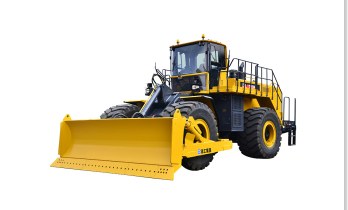
Rent a bulldozer
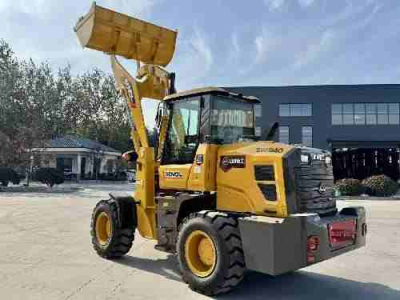
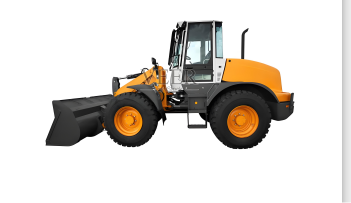
Here are the characteristics of wheel-type bulldozers in addition to the advantages mentioned before:
Good Operational Comfort
- Usually equipped with a spacious and comfortable cab with excellent visibility, allowing operators to clearly observe the work area.
- Advanced shock absorption technology and comfortable seats effectively reduce vibrations and bumps during driving and operation, minimizing operator fatigue.
High Operation Precision
- Sensitive steering and control systems enable operators to accurately control the driving direction and operation range of the bulldozer.
- Precise hydraulic system control allows fine adjustment of the bulldozer blade, meeting the precision requirements of different working conditions. For example, it can more accurately achieve the designed slope and flatness during site leveling.
Strong Versatility
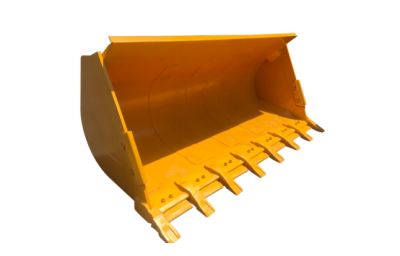
- In addition to basic earth-moving operations, it can achieve multiple functions by replacing different working attachments. For example, installing a loader bucket for loading operations or a ripper for breaking up hard soil or rock.
- Can collaborate with other construction machinery, such as loaders, excavators, and dump trucks, to form efficient construction workflows on job sites.
Better Environmental Performance
- Modern wheel-type bulldozers are typically equipped with engines using advanced fuel injection technology and exhaust purification devices, effectively reducing exhaust emissions and environmental pollution.
- Some wheel-type bulldozers also adopt noise reduction technology to lower operational noise levels, complying with environmental protection and urban construction requirements.
Product Details
Here is an introduction to bulldozers, a type of earth-moving construction machinery widely used in various engineering projects:
Working Principle
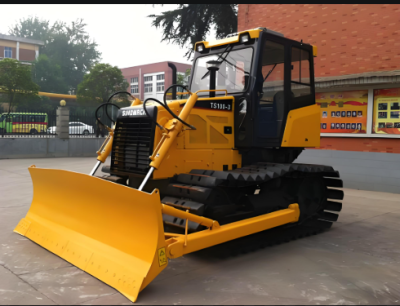
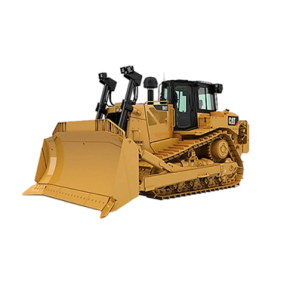
Bulldozers are primarily powered by an engine, which transmits power to the traveling gear and working equipment through a transmission system. The traveling gear moves the bulldozer forward or backward, while the blade in the working equipment is controlled by a hydraulic system to lift, tilt, and achieve earth-moving and leveling operations.
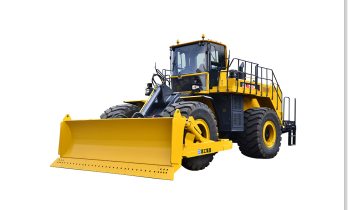
Structural Components
- Power System: Generally equipped with a diesel engine to provide strong power output for the bulldozer.
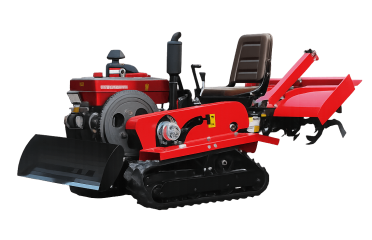
- Traveling Gear: There are two types: crawler-type and wheel-type. Crawler-type has high adhesion and good trafficability, suitable for complex terrains; wheel-type is fast and maneuverable, suitable for sites with better road conditions.
- Working Equipment: Mainly includes a blade, and some are equipped with a ripper. The blade is used for cutting and pushing soil; the ripper is used to break up hard soil or rock for subsequent earth-moving.
- Hydraulic System: Controls the movements of the working equipment, such as the lifting and tilting of the blade and the operation of the ripper, ensuring precise and flexible operation.
- Cab: Provides a comfortable working environment for operators, equipped with various control instruments and operating handles for convenient operation.
Application Scenarios
Bulldozers are widely used in engineering fields such as construction, road building, water conservancy, and mining:
- In construction projects: Used for site leveling and foundation excavation.
- In road construction: Performs subgrade treatment and pavement material pushing.
- In water conservancy projects: Used for dam construction and river dredging.
- In mining: Assists in overburden stripping and ore pushing.
Classification Methods
- By traveling mode: Divided into crawler bulldozers and wheel bulldozers.
- By engine power: Classified as small, medium, and large bulldozers.
- By purpose: Including general-purpose, wetland-type, sanitation-type, and other types to adapt to different working environments and requirements.
Leave your messages